Imagine going to work tomorrow and finding out your role has quietly become optional. Not gone yet. Just optional. That’s the uncomfortable reality facing millions of workers right now.
This isn’t fear-mongering. It’s math. And the math comes from the world’s most trusted labour-market researchers.
The World Economic Forum’s Future of Jobs Report 2025 surveyed over 1,000 employers. The survey spanned 55 economies and more than 14 million workers. Their conclusion was blunt: 92 million jobs will be displaced by 2030. Goldman Sachs goes further. It estimates 300 million jobs worldwide are exposed to generative AI automation in some form.
So, which jobs are actually first in line? Not vague predictions. Real, named occupations, ranked by real percentage declines, sourced from the same reports governments use to plan policy.
This guide walks through 15 careers facing the steepest AI-driven decline. We’ll explain why each one is vulnerable, back every claim with named sources, and then show you what to do about it. Stick around. The second half of this article might matter more to your future than the first.
Why Some Jobs Disappear Faster Than Others
Before naming names, let’s understand the pattern. Not every job facing “disruption” actually disappears. Some just change. Others vanish almost entirely.
Researchers measure this differently depending on their method. Back in 2013, Oxford academics Carl Benedikt Frey and Michael Osborne published a famous study. They estimated 47% of US jobs faced high automation risk. That number went viral, and it’s still quoted today.
However, the OECD pushed back hard on that figure. Economists Arntz, Gregory, and Zierahn argued automation hits tasks, not whole jobs. Most occupations mix automatable and non-automatable work. Their revised estimate? Just 9% of jobs in OECD countries face genuinely high risk.
So, which number is right? Honestly, both contain truth. Frey and Osborne tell us which job categories face the most pressure. The OECD reminds us that pressure rarely eliminates an entire profession overnight.
That’s the lens we’ll use here. Some roles, like data entry clerks, face near-total task automation. Others, like accountants, will shrink and transform rather than disappear completely. We’ll be clear about which is which.
The 15 Jobs Facing the Steepest AI-Driven Decline
Here’s the core list, built directly from WEF’s Future of Jobs Report 2025, Goldman Sachs research, and McKinsey’s automation studies. Each entry includes the actual projected decline where available.
1. Postal Service Clerks
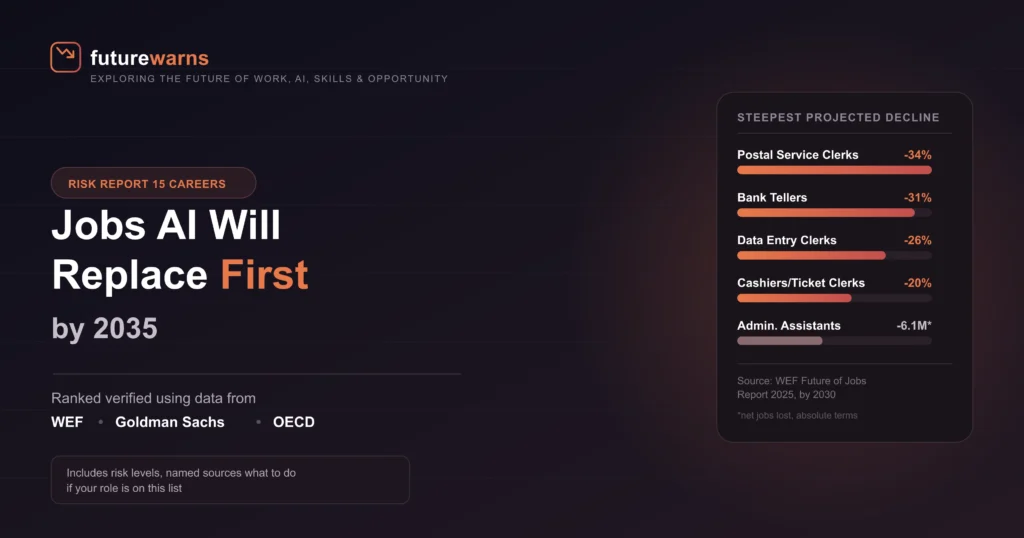
WEF data shows this role facing a 34% decline by 2030. That’s the single steepest drop of any occupation tracked. Digital communication and automated mail sorting have quietly gutted demand for manual postal processing.
2. Bank Tellers
Right behind postal clerks, bank tellers face a 31% projected decline. Mobile banking apps, ATMs, and AI-powered customer service now handle what tellers used to do, often faster and around the clock.
3. Data Entry Clerks
This one feels almost obvious in hindsight. WEF projects a 26% decline. But the absolute automation potential is even starker. Intelligent document processing tools now extract and classify unstructured data with over 97% accuracy. That figure comes from real industry deployments of platforms like Google Document AI.
4. Cashiers and Ticket Clerks
According to WEF’s own data, one in five cashier roles will disappear by 2030. That’s a 20% decline. In absolute terms, this is brutal. 16.3 million cashier positions are expected to be displaced. That accounts for nearly 18% of all projected job losses globally.
5. Administrative Assistants and Executive Secretaries
This role ranks second for absolute job losses worldwide, with a projected net decline of 6.1 million positions. AI scheduling tools, automated email triage, and virtual assistants have steadily eaten into tasks that once required a dedicated human assistant.
6. Material-Recording and Stock-Keeping Clerks
Warehouse digitization is brutal here. This category faces a projected net loss of 2.64 million jobs, driven by AI-powered inventory systems that track stock levels continuously without human counting or logging.
7. Accounting and Payroll Clerks
Projected net losses reach 1.65 million globally. AI-native accounting platforms now handle reconciliation, categorization, and payroll processing for a fraction of traditional costs. Industry surveys of accounting professionals report that a large majority, often cited around 81 to 83%, are already using AI tools in daily practice, with most saying it has measurably boosted productivity.
8. Telemarketers
The Oxford Frey-Osborne study assigned telemarketers a staggering 99% automation probability, the highest of any single occupation in their entire dataset. AI voice agents now handle cold calls, scripted pitches, and basic objection handling with unsettling fluency.
9. Customer Service Representatives
This is a massive workforce facing near-term pressure. The U.S. Bureau of Labor Statistics counted 2.9 million customer service representatives in the country as of 2023, making it one of the largest single occupations in the entire economy. WEF specifically flags this category as a top-impact vertical. Tools like Intercom’s Fin AI and enterprise platforms from Sierra and Gorgias now resolve complex queries that once required a live human agent.
10. Graphic Designers
For the first time, graphic designers appear on WEF’s declining-jobs list, with a projected net loss of 360,000 roles. Generative AI tools can now produce usable visual drafts in seconds, compressing demand at the execution level even as strategic design work remains valuable.
11. Printing Workers
Digital transformation and shrinking demand for physical print media have pushed this role firmly onto the WEF decline list. Fewer printed materials simply mean fewer hands needed to produce them.
12. Paralegals and Legal Document Reviewers
Goldman Sachs research found legal services among the most exposed sectors, projecting that 44% of legal industry tasks could be automated. AI-powered contract review and legal research tools now handle document analysis that once consumed hours of paralegal time.
13. Junior Financial Analysts and Bookkeepers
Business and financial operations face a projected 35% task automation rate, according to Goldman Sachs. Entry-level analytical work, the kind fresh graduates traditionally relied on to break into finance, is increasingly handled by AI models that can model scenarios and summarize reports instantly.
14. Translators and Basic Content Writers
This entry is harder to pin to one single statistic, and it’s worth being upfront about that. What’s verifiable is the tooling shift: generative tools like ChatGPT and Jasper already produce serviceable marketing copy and translations at a fraction of traditional cost. Industry analyses of the translation market describe machine-translation post-editing, where a human edits AI output rather than translating from scratch, as a fast-growing practice that can cut costs by 30 to 50% while preserving accuracy. That’s a real shift in how the work gets done, even without a single definitive “X% of jobs gone” figure to cite.
15. Retail Sales and Self-Checkout-Displaced Roles
Self-checkout stations have already reshaped grocery and big-box retail staffing. As AI-powered inventory and checkout systems mature further, in-store retail roles focused on basic transactions face continued, steady decline through the early 2030s.
Quick-Reference Comparison Chart
Numbers tell the story faster than paragraphs sometimes. Here’s how these roles stack up, based on WEF’s percentage decline data where available.
| Rank | Occupation | Projected Decline (WEF, by 2030) | Primary Driver |
|---|---|---|---|
| 1 | Postal Service Clerks | -34% | Digital communication, automated sorting |
| 2 | Bank Tellers | -31% | Mobile banking, AI customer service |
| 3 | Data Entry Clerks | -26% | Intelligent document processing |
| 4 | Cashiers and Ticket Clerks | -20% | Self-checkout, digital ticketing |
Note: these four figures all come from the same WEF metric, so they’re directly comparable. Telemarketers don’t appear in this particular table because their well-known “99%” figure comes from a different study, using a different method, explained in the next section.
Notice something? The steepest declines all involve repetitive, rule-based, low-ambiguity tasks. That pattern holds across every credible source we reviewed, from WEF to Goldman Sachs to McKinsey.
The Voices Behind the Warnings
Numbers matter, but so do the people sounding the alarm. Their words add urgency that statistics alone sometimes miss.
Dario Amodei, CEO of Anthropic, didn’t mince words during a Davos appearance. He warned that AI could eliminate as many as half of all entry-level white-collar jobs within one to five years, potentially pushing unemployment up to 20%. As he told Axios directly, “We, as the producers of this technology, have a duty and an obligation to be honest about what is coming. I don’t think this is on people’s radar.”
That’s a striking admission. It’s coming from someone building the very technology causing the disruption, not a critic on the outside looking in.
Meanwhile, Till Leopold, Head of Work, Wages and Job Creation at the World Economic Forum, frames the moment slightly differently. As he put it, trends such as generative AI and rapid technological shifts are upending industries and labour markets, creating both unprecedented opportunities and profound risks. He stresses that businesses and governments must work together now, not later, to build a resilient workforce.
Not everyone agrees on the severity, though. Nvidia CEO Jensen Huang has pushed back publicly against the most dire predictions, arguing that greater productivity historically leads to more hiring, not less. He’s criticized what he calls fear-driven narratives around AI’s labour impact.
So, who’s right? Probably elements of both. History shows technology destroys specific jobs while creating entirely new categories. The real question isn’t whether change is coming. It’s whether workers and policymakers prepare fast enough.
What Makes a Job Genuinely AI-Resistant
If the jobs above are vulnerable, what protects the ones that aren’t? Three consistent traits emerge across every major report we examined.
First, unpredictable physical environments matter enormously. A plumber tracking down a hidden leak relies on instinct built from experience, not a fixed checklist. Robots handle predictable factory work well. They struggle badly with messy, ever-changing real-world conditions.
Second, complex human judgment remains stubbornly valuable. Emergency responders making split-second decisions draw on training and gut feeling no machine currently replicates. The stakes are simply too high for pure automation.
Third, genuine creativity and strategic thinking still resist replication. AI can generate a serviceable first draft. It cannot yet decide which problem is actually worth solving, or read a room well enough to deliver difficult news with real empathy.
BlackRock CEO Larry Fink offers a useful, if sobering, way to think about this shift. Speaking at BlackRock’s 2026 Infrastructure Summit, he warned that this year’s college graduates could face the highest unemployment in years, even without a recession, adding plainly that AI “is going to disrupt many of those types of jobs” that once needed only a college degree. His prescribed fix isn’t reassurance. It’s redirection: he points to skilled trades, especially the electricians and tradespeople building AI’s physical infrastructure, as the clearest near-term growth area, backed by a $100 million BlackRock initiative aiming to place 50,000 workers into those trades over five years.
The Industries Bearing the Heaviest Load
Zooming out from individual jobs, certain entire industries carry disproportionate exposure. Understanding this helps explain why some careers face faster decline than others nearby.
Administrative and clerical work tops nearly every list. Goldman Sachs projects 46% of administrative tasks face automation exposure, the highest of any sector they measured. That single statistic explains why so many entries on our list above are clerical in nature.
Legal services follow closely, with Goldman Sachs estimating 44% task exposure. Architecture and engineering sit at 37%, while business and financial operations come in around 35%. Community and social services, somewhat surprisingly, show 33% exposure too.
By contrast, sectors involving physically demanding or outdoor work show, in Goldman Sachs’s own words, “little effect” from current AI automation trends. Construction, repair work, and skilled trades remain comparatively insulated for now.
This pattern isn’t random. It tracks almost perfectly with how predictable and digitizable a sector’s core tasks are. The more a job resembles processing structured information, the more exposed it becomes.
A Word of Caution on These Predictions
It would be dishonest to present these numbers as guaranteed outcomes. Forecasting labour markets a decade out is genuinely hard, and history is full of predictions that missed badly.
The OECD’s critique of the original Frey-Osborne study matters here. Jobs rarely disappear in one clean sweep. They erode gradually, task by task, while workers shift toward the remaining human-essential parts of their role.
Consider bank tellers again. Banks haven’t eliminated branches entirely. Instead, teller roles have shifted toward complex problem-solving, financial advising, and relationship-building, the parts ATMs and apps still can’t handle.
McKinsey’s own research echoes this nuance. Even in their more aggressive 2023 estimate, suggesting 60-70% of work activities could theoretically be automated, the report’s authors stress that most jobs and industries are only partially exposed to automation and are more likely to be complemented rather than substituted by AI.
That distinction, complemented versus substituted, deserves real weight. It’s the difference between a job evolving and a job vanishing entirely.
What Workers in At-Risk Roles Should Actually Do
Knowing your role is exposed is only useful if it leads to action. So, what should someone in one of these 15 careers actually do right now?
Start by identifying the non-automatable slice of your current job. Every clerical role still contains moments requiring judgment, empathy, or relationship management. Lean into those deliberately, and document them as your value proposition.
Next, treat AI tools as collaborators, not threats, wherever realistically possible. A bookkeeper who learns to operate AI-native accounting platforms becomes the person overseeing the system, not the person the system replaces.
Build adjacent skills steadily, rather than waiting for a crisis. The World Economic Forum’s own research shows resilience, flexibility, and analytical thinking rank among the most valuable skills through 2030, regardless of industry.
Finally, watch your specific occupation’s task mix closely, not just broad industry headlines. A customer service representative handling complex technical escalations faces a different risk profile than one handling simple password resets, even though both share a job title.
Frequently Asked Questions
Will these 15 jobs disappear completely by 2035?
Unlikely in most cases. WEF and OECD data both suggest gradual task-level erosion rather than complete occupational disappearance, except in the most extreme cases like data entry and telemarketing, where automation potential approaches 99%.
Which single job faces the highest automation risk?
Telemarketers, according to the original Oxford Frey-Osborne study, which assigned this role a 99% automation probability, the highest of any occupation examined.
Are white-collar or blue-collar jobs more at risk?
Current evidence leans white-collar. Goldman Sachs explicitly notes that administrative workers and lawyers face more risk than physically demanding outdoor occupations like construction and repair work.
Can reskilling actually protect someone in these roles?
Yes, with caveats. WEF estimates 59% of the global workforce will need reskilling by 2030, and 29 out of every 100 workers could be successfully upskilled within their current roles. However, 11% may not receive adequate training access, highlighting real inequality in who benefits from reskilling efforts.
Is the 300 million jobs figure from Goldman Sachs realistic?
It represents jobs “exposed” to automation, not jobs guaranteed to disappear. Goldman Sachs itself notes most affected roles will see 25-50% of their workload automated, not complete elimination, and stresses most jobs will be complemented rather than substituted.
The Bottom Line
Here’s the honest summary. These 15 careers face real, well-documented, data-backed risk. That much isn’t in dispute among WEF, Goldman Sachs, McKinsey, or the OECD.
But risk isn’t destiny. The same reports warning about decline also describe a parallel surge in new opportunities, from AI oversight roles to human-AI collaboration specialists. Disruption and creation are happening simultaneously, not sequentially.
The workers who navigate this best won’t be the ones who ignore the warning signs, nor the ones who panic. They’ll be the ones who read reports exactly like this one, identify their specific exposure honestly, and start adapting years before the pressure becomes unavoidable.
As Till Leopold put it, the time is now for businesses and governments to work together, invest in skills, and build a resilient global workforce. That advice applies just as directly to individuals reading this today.
Sources: World Economic Forum, Future of Jobs Report 2025; Goldman Sachs, “The Potentially Large Effects of Artificial Intelligence on Economic Growth” (2023); Oxford University, Frey & Osborne, “The Future of Employment” (2013/2017); OECD, Arntz, Gregory & Zierahn automation research; McKinsey Global Institute; U.S. Bureau of Labor Statistics; Dario Amodei, Axios interview and Davos remarks; Larry Fink, BlackRock 2026 Infrastructure Summit and Annual Chairman’s Letter. All statistics current as of mid-2026 and subject to revision in future reporting cycles.