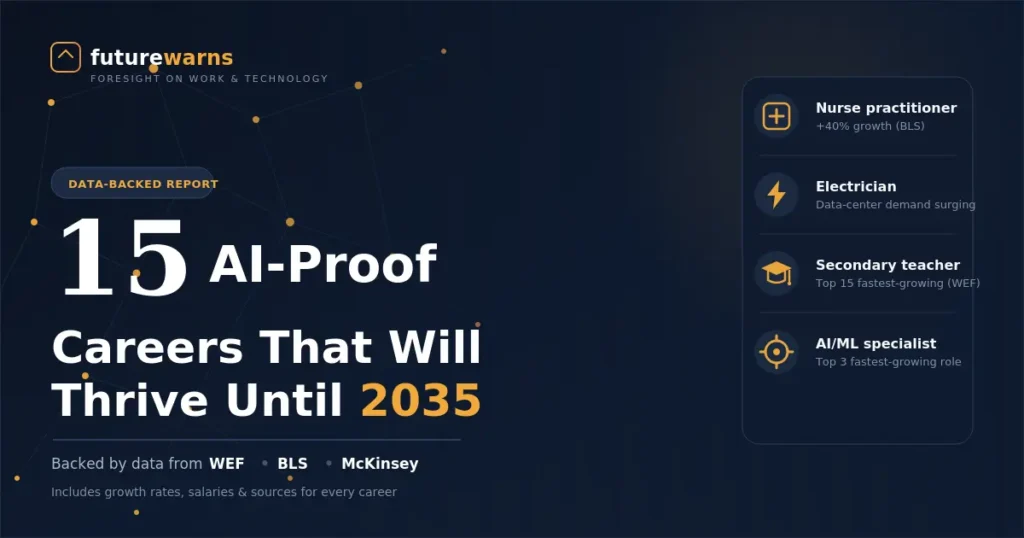
Every year, a new headline tells you that artificial intelligence is coming for your job. But here’s the question almost nobody answers with real numbers: which jobs are actually safe — and why?
This isn’t a listicle built on guesswork. It’s built on the same datasets that governments and Fortune 500 companies use to plan workforce strategy: the World Economic Forum’s Future of Jobs Report 2025, the U.S. Bureau of Labor Statistics’ Employment Projections 2024–2034, and McKinsey Global Institute’s automation research. Together, these sources surveyed over 1,000 global employers representing 14 million workers across 55 economies — and they all point to the same conclusion: AI doesn’t erase work. It redraws the map of where work happens.
According to the WEF, technological disruption will displace 92 million jobs by 2030 — but it will simultaneously create 170 million new ones, a net gain of 78 million jobs worldwide. The roles least likely to disappear share three traits: they demand physical adaptability in unpredictable environments, complex human judgment, or deep emotional and ethical reasoning. Exactly the territory where today’s AI, however impressive, still falls flat.
As Robert Seamans, PhD, of NYU Stern School of Business, put it plainly: “Very few jobs will be replaced by AI.” The real story isn’t replacement — it’s transformation. And if you choose the right career, that transformation works in your favor, not against you.
Below are 15 careers that the data say will not just survive the AI decade but thrive in it — complete with growth percentages, salary benchmarks, and the specific reasons each one resists automation.
Why Some Jobs Are Immune to AI (And Others Aren’t)
McKinsey Global Institute’s landmark automation research found that activities most susceptible to automation are physical tasks performed in predictable environments, along with collecting and processing data — think assembly-line work, data entry, and routine paralegal review. Conversely, automation has a much smaller effect on jobs that involve managing people, applying specialized expertise, and engaging in social interaction, where machines simply can’t match human performance.
There’s a second, less obvious category McKinsey flags: jobs in unpredictable physical environments — gardeners, plumbers, child- and elder-care providers — which remain technically difficult to automate and economically unattractive to robotize.
So every career on this list clears at least one of these three filters:
- Unpredictable physical work — no two job sites, patients, or repairs are identical
- High-stakes human judgment — decisions involve ethics, trust, or life-and-death consequences
- Genuine emotional or creative connection — the value lies in being human, not in being efficient
Let’s get into the careers themselves.
1. Nurse Practitioner (NP)
Projected growth (2024–2034): 40% | Median salary: $129,210/year | Source: U.S. Bureau of Labor Statistics
Nurse practitioners rank as the third-fastest-growing occupation in the entire U.S. economy, behind only wind turbine service technicians (50%) and solar photovoltaic installers (42%) — and they’re the single fastest-growing healthcare occupation by a wide margin. Employment of NPs, nurse anesthetists, and nurse midwives is expected to grow 40% from 2024 to 2034 — far faster than the average for all occupations, with roughly 32,700 openings projected every year of the decade.
Why is this role so resistant to AI? Because it combines diagnostic reasoning with hands-on physical examination, emotional reassurance, and split-second clinical judgment in situations that rarely follow a script. AI can flag an abnormal lab value, but it cannot hold a frightened patient’s hand, adapt a treatment plan to a person’s home situation, or make the ethical call on a borderline case. As the aging U.S. population grows and physician shortages deepen, healthcare providers are increasingly relying on nurse practitioners and physician assistants to deliver care under a collaborative, team-based model — a trend AI accelerates rather than threatens, since it frees clinicians from paperwork to spend more time with patients.
How to break in: A Master of Science in Nursing (MSN) or Doctor of Nursing Practice (DNP), built on an RN foundation, with board certification in a specialty (family practice, psychiatric-mental health, acute care).
2. Physician Assistant
Projected growth: 20% | Median salary: $133,260/year | Source: BLS Occupational Outlook Handbook
Physician assistants sit right behind nurse practitioners on almost every “fastest-growing” list, for the same structural reason: an aging population needs more hands-on care than the physician pipeline alone can supply. PAs diagnose illness, set treatment plans, perform procedures, and — crucially — read a room. A patient’s body language, fear, or unspoken question is data no algorithm currently captures. AI can support a PA by summarizing charts or flagging drug interactions, but the decision of how to deliver difficult news, or whether a borderline symptom warrants further testing, remains a profoundly human judgment call.
How to break in: A master’s degree from an accredited PA program (typically 2–3 years post-bachelor’s), followed by the PANCE certification exam.
3. Skilled Trades: Electricians
Projected growth: 9–9.5% (more than triple the U.S. average) | Median salary: $62,350/year, with specialists exceeding $100,000–$280,000 | Source: BLS, JLL Global Data Center Outlook
Here’s the irony AI critics rarely mention: the AI boom itself is the biggest job creator for electricians in a generation. Data centers — the physical infrastructure that runs every large language model — need to be wired, cooled, and maintained by humans. Electrical work accounts for an estimated 45% to 70% of total data-center construction costs, and the U.S. will need roughly 300,000 new electricians over the next decade, on top of replacing the 200,000 expected to retire.
Nvidia CEO Jensen Huang summed it up at Davos, calling the AI infrastructure boom “the largest infrastructure build-out in human history,” one that “is going to create a lot of jobs” for plumbers, electricians, and steelworkers. Some of those jobs pay astonishingly well: TV host Mike Rowe, of Dirty Jobs fame, recently said he met electricians under 30 earning between $240,000 and $280,000 a year.
Why can’t a robot just do this instead? Because every building is different. Wiring runs behind walls in places no blueprint shows, panels sit in cramped corners, and a single mistake in a data center can cause millions in downtime. As one industry analysis put it bluntly: “AI cannot create electricians. It cannot replace a qualified commissioning agent.”
How to break in: A 4–5 year paid apprenticeship combining on-the-job training with classroom instruction, followed by a state licensing exam for journeyman status.
4. Plumbers, Pipefitters & HVAC Technicians
Projected growth: 4–8.1% | Median salary: $51,000–$80,000, with master plumbers and HVAC specialists topping $120,000–$150,000 | Source: BLS, ABC Greater Tennessee
Pipes break. Furnaces fail in January. Air conditioning dies in July. None of that depends on the economy, and none of it can be diagnosed remotely by a chatbot. Median salaries for electricians, plumbers, and HVAC technicians now range from $60,000 to $80,000, with top earners clearing six figures, while the construction industry alone is short more than 500,000 skilled workers in 2026.
The retirement wave compounds the shortage: roughly one in four skilled tradespeople are expected to retire by 2030, and the pipeline of new entrants hasn’t kept pace — partly because 74% of Gen Z workers report a cultural stigma around choosing vocational training over a four-year degree. That stigma, ironically, is what makes this such a strong opportunity: less competition, rising wages, and zero risk of an AI doing your job from a server farm.
How to break in: Trade school certificate (6 months–2 years for HVAC) or a formal apprenticeship (4–5 years for plumbing), plus state licensure.
5. Mental Health Counselors & Therapists
Projected growth: 17% | Median salary: $59,190/year | Source: BLS Occupational Outlook Handbook, Substance Abuse, Behavioral Disorder, and Mental Health Counselors
AI chatbots can offer scripted coping techniques, but licensed therapy involves something fundamentally different: a trust relationship built over months or years, the ability to read subtext in a pause or a tone of voice, and the legal and ethical responsibility that comes with diagnosing and treating real human suffering. The broader community and social service occupations group — which includes counselors — is projected to grow due to more individuals seeking assistance for a variety of challenges, such as marriage and family counseling as well as substance abuse counseling, a trend mental health professionals expect only to intensify as awareness around therapy grows and stigma declines.
AI can responsibly support this field — helping clinicians with note-taking or session prep — but the therapeutic alliance itself, the thing that actually produces healing, is irreducibly human.
How to break in: A master’s degree in counseling, psychology, or social work, plus thousands of supervised clinical hours and state licensure (LPC, LCSW, or LMFT).
6. Special Education & Secondary School Teachers
Projected growth: Secondary education roles set to add 1.6 million jobs; tertiary education to add 1.9 million by 2030 | Median salary: Varies by state, generally $55,000–$75,000 | Source: World Economic Forum, Future of Jobs Report 2025
The WEF’s 2025 report places education roles squarely among the fastest-growing job categories globally, driven by expanding working-age populations in lower-income economies and rising demand for secondary education teachers. AI tutoring tools are genuinely useful — but they cannot manage a classroom of 30 teenagers, mediate a conflict between students, notice that a quiet child might be struggling at home, or inspire a kid who’s given up on themselves. Teaching is relationship-driven work disguised as content delivery, and the relationship part is what AI can’t touch.
How to break in: A bachelor’s degree in education or a subject specialty, plus state teaching certification; many districts now also value experience integrating AI tools into curricula, which is becoming a hiring differentiator rather than a threat.
7. Choreographers and Performing Artists
Projected growth (2024–2034): 5% for dancers and choreographers combined | Median salary: $73,100/year for choreographers | Source: BLS Occupational Outlook Handbook
It’s worth noting upfront: this occupation’s growth rate has actually been revised down in BLS’s most recent projection cycle compared to earlier estimates, which is a useful reminder that even “safe” creative careers are a relatively small, niche occupational category (only about 4,600 choreographer jobs existed in 2024) where year-to-year projections can shift. Still, dancers and choreographers are projected to grow faster than the average for all occupations, and the reason they remain resistant to automation has nothing to do with growth rate and everything to do with the nature of the work itself: choreography requires originality, an intuitive sense of how human bodies move and emote in three-dimensional space, and the ability to translate abstract feeling into physical performance for a live audience. Creativity, originality, and social skills are qualities AI and robots cannot easily replicate — and audiences pay specifically to watch a human push their body to its expressive limit, not a simulation of one. The BLS also notes that growing social media reach is helping generate new interest in dance performance, even as funding constraints for the arts remain a headwind.
How to break in: Formal dance training plus performance experience; many choreographers build reputations through company work, competitions, and collaborative projects before going independent.
8. Software Developers (Yes, Really)
Projected growth: 16% (adding 267,700 jobs) | Median salary: $133,080/year | Source: BLS Employment Projections 2024–2034
It sounds paradoxical: AI writes code, so why would coders be safe? Because someone has to architect the system AI is writing code for, decide what to build, debug the parts AI gets subtly wrong, integrate it with legacy infrastructure, and take responsibility when it fails in production. Software developers aren’t being replaced by AI — they’re the ones building the tools that run it. The BLS projects software developer employment to add 267,700 new jobs by 2034 — one of the largest numeric gains of any occupation in the economy — and explicitly cites continued expansion of software development for AI, the Internet of Things, robotics, and other automation applications as a key driver of that demand.
The skill that matters now isn’t typing syntax — it’s systems thinking, security awareness, and the judgment to know when AI-generated code is actually correct. As the WEF notes, AI and big data top the list of the fastest-growing skills employers are seeking, and developers who learn to direct AI tools rather than compete with them are pulling further ahead of the pack, not falling behind.
How to break in: A computer science degree, bootcamp, or self-taught portfolio — increasingly, demonstrated fluency with AI-assisted development tools matters as much as the credential itself.
9. AI and Machine Learning Specialists (The Builders of the Disruption)
Projected growth: Among the top 3 fastest-growing jobs globally by 2030 (percentage terms) | Median salary: $130,000–$200,000+ | Source: World Economic Forum, Future of Jobs Report 2025
There’s a delicious irony here: the single fastest-growing category of jobs because of AI is jobs building AI. According to the WEF’s Future of Jobs Report 2025, the three fastest-growing jobs in percentage terms worldwide are big data specialists, fintech engineers, and AI and machine learning specialists, in that order — with software and application developers close behind in fourth place. A striking 86% of employers surveyed expect AI and information processing technologies to transform their business by 2030, and over two-thirds plan to actively hire for AI-specific roles in the next five years, even as the same companies expect AI to reshape other parts of their workforce.
This isn’t a niche, either — it spans data engineering, model evaluation, AI safety, applied research, and “AI integration” roles that translate raw model capability into working business systems. As one career analyst on Quora put it, becoming the technical bridge between AI developers and the businesses deploying these systems is “pretty much going to be the cake career for the next generation.”
How to break in: A degree in computer science, statistics, or data science, paired with hands-on project experience; many top performers in this field are self-taught through applied projects and open-source contribution.
10. Renewable Energy & Environmental Engineers
Projected growth: Among the top 15 fastest-growing roles globally | Median salary: $80,000–$100,000+ | Source: World Economic Forum, Future of Jobs Report 2025
The green transition is reshaping labor demand almost as forcefully as AI itself. Autonomous and electric vehicle specialists, environmental engineers, and renewable energy engineers all rank among the fastest-growing professions worldwide, driven by climate policy, decarbonization targets, and the genuinely physical work of building solar farms, wind installations, and EV charging infrastructure. Green skills demand grew 22% between 2022 and 2023 alone, consistently outpacing supply — meaning qualified engineers in this space face a hiring market tilted heavily in their favor.
This work blends technical design with field deployment in conditions that vary by terrain, weather, and grid infrastructure — exactly the kind of “unpredictable environment” work that resists full automation.
How to break in: A bachelor’s degree in environmental, electrical, or mechanical engineering, often supplemented with sustainability or renewable-systems certifications.
11. Wind Turbine Service Technicians & Solar Photovoltaic Installers
Projected growth: 50% (wind) and 42% (solar) — the two fastest-growing occupations in the entire U.S. economy | Median salary: $51,860–$62,580 | Source: U.S. Bureau of Labor Statistics
According to the BLS’s most recent decade-long projections, wind turbine service technician jobs are projected to increase 50% by 2034 — the single fastest growth rate of any occupation the agency tracks — with solar photovoltaic installers close behind at 42%. These are climbing, hands-on jobs performed hundreds of feet in the air or scattered across rooftops — physically demanding work in conditions a robot would need millions of dollars in custom engineering to even attempt safely. The BLS notes the absolute number of jobs added is modest since this remains a smaller occupational category — the two combined will add fewer than 20,000 new jobs — but as a career bet, the growth trajectory and the renewable-energy tailwind behind it are hard to beat.
How to break in: A technical certificate program (often under a year), combined with on-the-job safety training; some employers also require OSHA certification for height work.
12. Construction Workers and Construction Managers
Projected growth: Among the largest absolute job gains worldwide through 2030; U.S. construction managers specifically projected to grow 9% (2024–2034) | Median salary: $48,000 (laborers) to $106,980 (construction managers) | Source: World Economic Forum, Future of Jobs Report 2025; U.S. Bureau of Labor Statistics
Buildings, bridges, and the data centers powering AI itself all require human builders. The WEF report places building construction workers among the top five jobs by absolute growth globally, alongside farmworkers and delivery drivers — a reminder that the AI economy still runs on a foundation of physical infrastructure that doesn’t build itself. As one industry executive observed about the broader skilled-trades and construction ecosystem, “you can’t have AI without data centers supporting them” — and you can’t have those data centers without the people who physically construct them.
How to break in: Entry-level laborer positions require no formal credential; supervisory and management tracks typically need an associate’s or bachelor’s degree in construction management, or years of field experience plus certification (such as a Project Management Professional credential).
13. Personal Care Aides & Home Health Aides
Projected growth: Adds more new jobs than any other single occupation in the U.S. economy — 739,800 by 2034 | Median salary: $34,900/year | Source: USA Facts, citing BLS data
This is the single largest job-growth category in raw numbers anywhere in the American economy, and the reason is demographic, not technological: the U.S. population is aging fast, and people need help bathing, dressing, eating, and simply not being alone. Home health and personal care aide roles are projected to gain nearly 740,000 new positions by 2034 — more than double any other occupation. The pay is modest, which is precisely why automation isn’t coming for it: McKinsey notes that unpredictable physical jobs that also tend to be lower wage make automation a less economically attractive investment for employers, since building and maintaining a caregiving robot would cost vastly more than simply paying a human.
How to break in: Most states require only a short certification course (often a few weeks); compassion, patience, and physical stamina matter more than credentials here.
14. Skilled Trades: Welders, Carpenters & Machinists
Projected growth: Welders up 25% in postings over three years; carpenters projected 4% BLS growth with 74,100 annual openings | Median salary: $48,000–$63,000, with specialized welders (underwater, pipe-certified) earning significantly more | Source: BLS, Randstad workforce analysis
Demand here is exploding, specifically due to AI infrastructure spending. A Randstad analysis of more than 50 million job postings found demand for robotics technicians up 107%, and welders and electricians up 25% and 18% respectively over the past three years — driven almost entirely by the physical build-out AI requires. Yet the supply side is collapsing for every 100 young people entering manufacturing, 102 leave, a net negative pipeline that’s pushing wages up across the board.
How to break in: Trade school or community college certificate programs (6 months to 2 years), often followed by employer-sponsored apprenticeships.
15. C-Suite Leaders, Executives & People Managers
Projected growth: Leadership and people-management skills rank among the top 10 fastest-growing competencies through 2030 | Median salary: Highly variable, often six figures and above | Source: World Economic Forum / McKinsey leadership research
The final entry on this list isn’t an entry-level career, but it’s arguably the most automation-resistant role of all. Leadership decisions are driven by values, politics, conflicting interests, and cultural trade-offs rather than pure data — and vision, trust, and ethical responsibility simply cannot be automated. Analytical thinking remains the single most sought-after skill among employers, with seven in ten companies calling it essential, followed closely by resilience, flexibility, and leadership itself.
AI is becoming an extraordinarily useful chief-of-staff for leaders — running scenario simulations, summarizing meetings, tracking goals — but as one analysis succinctly framed it, roughly 80% of leadership work stays stubbornly, permanently human: vision-setting, culture-building, conflict resolution, and leading people through change.
How to break in: No single path — typically built through years of progressively senior operational experience, often paired with an MBA or equivalent business education, but increasingly earned through demonstrated judgment rather than credentials alone.
The Pattern Behind All 15 Careers
Look across this list and a clear blueprint emerges. Every single one of these roles involves at least one of the following, almost always layered with the others:
| Resistance Factor | Examples From This List |
|---|---|
| Unpredictable physical environments | Electricians, plumbers, HVAC techs, construction workers |
| High-stakes human judgment & ethics | Nurse practitioners, physician assistants, executives |
| Genuine emotional connection & trust | Therapists, teachers, personal care aides |
| Embodied creativity | Choreographers, performing artists |
| Building/directing the AI systems themselves | Software developers, ML specialists |
| Demographic or policy tailwinds | Green energy engineers, healthcare roles, education |
As the World Economic Forum’s Head of Work, Wages and Job Creation, Till Leopold, put it: “Trends such as generative AI and rapid technological shifts are upending industries and labour markets, creating both unprecedented opportunities and profound risks.” The risk is real for routine, predictable, screen-based work. The opportunity is just as real for anyone willing to build skills in the categories above.
What the Data Says You Should Actually Do About It
A few numbers should shape your next move, regardless of which career on this list appeals to you:
- 39% of core workplace skills will change by 2030, according to the WEF’s Future of Jobs Report 2025 — meaning continuous learning isn’t optional anymore, even within “safe” careers.
- 85% of employers plan to prioritize workforce upskilling by 2030, and 50% of workers have already undergone some form of retraining, up sharply from 41% just two years earlier.
- Workers in the lowest wage quintiles are up to 14 times more likely to need to switch occupations entirely than top earners, per McKinsey’s research on generative AI’s labor impact — underscoring why skill-building now beats waiting and reacting later.
The single most actionable insight from all three reports — WEF, BLS, and McKinsey — is this: the safest career isn’t necessarily the one immune to AI. It’s the one where you learn to direct AI rather than compete with it. Software developers aren’t growing despite AI — they’re growing because they build it. Electricians aren’t growing despite the AI boom — they’re growing because someone has to wire the buildings that run it.
AI is not eliminating work. It is changing the nature of work.
As legendary management thinker Peter Drucker once said: “The best way to predict the future is to create it.”
Frequently Asked Questions
Will any job be 100% safe from AI by 2035?
No credible source claims total immunity. Even the careers above will change in how they’re performed — nurses will use AI diagnostic support, teachers will use AI tutoring tools, and electricians will work on AI-powered building systems. What stays constant is the human core of the work: judgment, trust, physical adaptability, and creativity.
Are skilled trades really better bets than white-collar AI jobs?
The data suggests both can thrive, but for different reasons. Trades benefit from a structural shortage — JLL estimates 2.1 million skilled trades positions could go unfilled by 2030 — while AI-adjacent white-collar roles benefit from surging demand for the technology itself. The strongest strategy may be combining both: technically literate trades workers (think data-center electricians) are now among the highest earners in either category.
Should I avoid jobs that AI tools already assist with, like coding or nursing documentation?
No — assistance isn’t replacement. The BLS and WEF both frame AI as primarily augmenting these roles by removing repetitive sub-tasks (paperwork, basic code generation, scheduling), freeing professionals to focus on the higher-judgment work that actually requires a human.
What’s the fastest way to future-proof a career already at risk?
Build skills in the resistance categories above — particularly AI literacy paired with a human-judgment specialty. The WEF found that AI and big data, networks and cybersecurity, and technology literacy are the three fastest-growing skill categories employers want — but they consistently rank alongside creative thinking, resilience, and leadership, not instead of them.
The Bottom Line
The headlines about AI ending careers are mostly half-true: AI is ending tasks, not professions. Every credible labor-market source — the World Economic Forum, the U.S. Bureau of Labor Statistics, and McKinsey Global Institute — agrees that the jobs disappearing are the predictable, repetitive, screen-based ones, while jobs requiring physical adaptability, trust, judgment, and creativity are growing faster than the broader economy.
If you’re choosing a career today, or deciding whether to pivot one you’re already in, the smartest move isn’t to find a job AI can never touch — that job doesn’t exist. It’s to build a career sitting at the intersection of human skill and AI infrastructure, where demand is compounding from both directions at once. Based on the data, that’s exactly where the next decade of opportunity lives.
Sources: World Economic Forum, Future of Jobs Report 2025; U.S. Bureau of Labor Statistics, Employment Projections 2024–2034 and Occupational Outlook Handbook; McKinsey Global Institute, “Jobs Lost, Jobs Gained” and “Generative AI and the Future of Work in America”; JLL Global Data Center Outlook 2026; Associated Builders and Contractors workforce data; Randstad Workforce Insights. All statistics are current as of mid-2026 and subject to revision in future reporting cycles.