Picture this. You send one instruction to your computer. Then you walk away. No follow-up clicks. No second prompt. Yet the task gets done anyway. That is not science fiction anymore. That is an AI Agents at work.
In 2025, fewer than 5% of enterprise apps had one built in. By the end of 2026, Gartner expects that number to hit 40%. That is not slow growth. That is a takeover. And it raises one urgent question for anyone in business, tech, or just daily life: what exactly is an AI agent, and why does everyone suddenly care?
This guide answers that question in full. We will cover the real definition, the history behind it, how agents actually work, and where they already run today. We will also look at the risks, because not every agent story has a happy ending. Stick with us. By the end, you will understand this technology better than most people writing about it online.
What Is an AI Agent? A Clear Definition
An AI agent is a software system that can perceive its environment, make decisions, and take action on its own. It does this to reach a specific goal. Unlike a basic chatbot, it does not wait for you to spell out every step.
IBM puts it simply. An AI agent is a system or program that is capable of autonomously performing tasks on behalf of a user or another system by designing its workflow and utilizing available tools. That phrase, “designing its workflow,” is the key. The agent figures out how to do the job. You only tell it what the job is.
This idea is not brand new. Computer scientists Stuart Russell and Peter Norvig laid the groundwork back in 1995. Their textbook, still used in universities worldwide, defines an agent as anything that can be viewed as perceiving its environment through sensors and acting upon that environment through actuators. A thermostat technically fits that definition. So does a robot vacuum. But today’s AI agents go much further. They reason. They plan. They adapt.
So, what changed? Large language models changed everything. Before 2023, “agents” mostly lived in research papers. Now, thanks to models like GPT-4 and Claude, agents can understand messy human language, break a goal into steps, and call outside tools to finish the job. That leap explains why this topic exploded almost overnight.
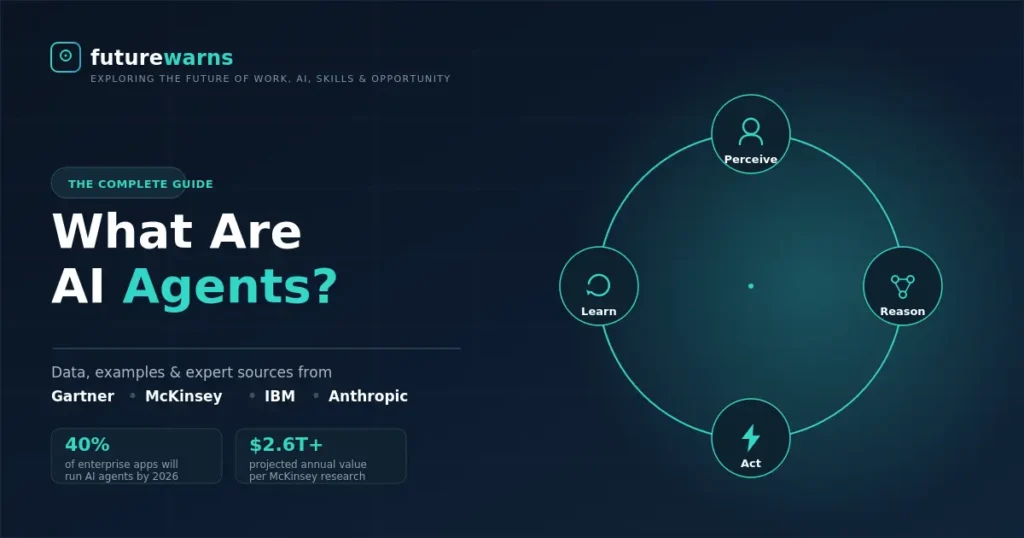
How AI Agents Actually Work: The Four Core Components
Every genuine AI agent, no matter how simple or advanced, relies on four building blocks. Understanding these makes the whole concept far less mysterious.
First, perception. This is how the agent senses its world. For a chatbot-style agent, perception means reading and understanding your text. For a self-driving car, it means cameras and sensors. IBM explains that AI agents use perception to assess the environment and then choose actions that maximize their overall satisfaction or performance.
Second, reasoning. This is the brain of the operation. The agent weighs options, checks facts, and plans next steps. According to IBM, the reasoning module determines how an agent reacts to its environment by weighing different factors, evaluating probabilities and applying logical rules or learned behaviors. Two popular reasoning styles exist today. One is called ReAct, short for Reasoning and Action. The other is ReWOO, which skips constant observation to save time and cost.
Third, action. Thinking alone gets nothing done. The agent must act. This is often called “tool calling.” IBM notes that agents turn to available tools such as external datasets when they lack the knowledge to finish a task alone. In practice, this means an agent might search the web, query a database, send an email, or write and run code, all without a human clicking a single button.
Fourth, learning. The best agents improve with use. They remember past mistakes. They refine their approach. This feedback loop, as IBM describes it, helps an agent avoid repeating the same error twice.
Together, these four pieces form what researchers call the perception-reasoning-action-learning loop. Miss one piece, and you do not have a true agent. You have, at best, a clever script.
Five Types of AI Agents You Should Know
Not all agents are built the same way. Some are simple. Some are remarkably sophisticated. Knowing the difference helps you spot real innovation versus marketing hype.
Simple reflex agents follow basic “if this, then that” rules. A thermostat is the classic example. These agents cannot plan ahead, and they ignore history. They just react.
Model-based agents keep an internal model of their surroundings. This lets them handle situations they cannot fully see. Think of a robot that remembers a room’s layout even when a wall blocks its camera.
Goal-based agents look further ahead. They pick actions based on whether those actions move them closer to a defined goal, not just an immediate reaction.
Utility-based agents go one step further still. Instead of just reaching a goal, they weigh how well each path achieves it. This matters when multiple solutions exist but some are clearly better than others.
Learning agents improve continuously. They use feedback to refine future behavior, much like a junior employee who gets sharper with every passed quarter.
Most cutting-edge systems today, especially those built on large language models, blend several of these types together. A modern customer service agent, for instance, often combines goal-based planning with learning-based refinement.
A Brief History: From Lab Theory to Daily Reality
The term “agent” is older than most people assume. It traces back to the Latin word agere, meaning “to do.” For decades, the concept stayed mostly inside computer science classrooms.
Early agents in the 1990s and 2000s were narrow. They handled one task, like sorting email or managing a thermostat. They followed strict rules. There was no flexibility and no real understanding of language.
Then came the transformer revolution. Around 2017, a new type of neural network made it possible to process language with stunning nuance. By 2022 and 2023, models built on this architecture, like ChatGPT, showed the world that machines could finally hold a real conversation.
But conversation alone is not agency. The real shift happened when developers gave these language models tools. Suddenly, a model could not only chat, it could search the internet, write code, and check its own work. Anthropic, the company behind Claude, captured this shift well in its influential research note on the topic. As Anthropic explains, the defining trait of a true agent is that it dynamically directs its own processes and tool usage, maintaining control over how it accomplishes tasks.
That single distinction, between rigid workflows and dynamic agents, is now the backbone of how the entire industry talks about this technology.
AI Agents vs. Chatbots vs. RPA: What’s the Real Difference?
People often confuse these three terms. They are not the same thing, and the difference actually matters.
A traditional chatbot follows a script. ServiceNow describes it well: chatbots follow fixed scripts, capable of handling simple queries rather than complex or evolving tasks. Ask it something outside its script, and it stumbles or hands you off to a human.
Robotic Process Automation, or RPA, is older still. It automates repetitive digital tasks, like copying data from one spreadsheet to another. But RPA cannot improvise. Change one small detail in the process, and it breaks.
An AI agent does neither of those things. It does not need a script, and it does not need a fixed process map. IBM draws this line clearly: nonagentic chatbots are ones without available tools, memory or reasoning, and require continuous user input to respond. An agentic chatbot, by contrast, plans, remembers, and acts largely on its own.
Here is a simple way to remember it. A chatbot answers. RPA repeats. An agent decides.
Real-World Examples: Where AI Agents Already Work Today
Theory only gets you so far. Let’s look at what is actually happening right now, inside real companies, with real results.
Customer service at Klarna. In February 2024, the Swedish fintech company launched an OpenAI-powered assistant. The results were striking at first. The AI assistant had 2.3 million conversations in its first month, doing the equivalent work of 700 full-time agents. Resolution times dropped from 11 minutes to under 2 minutes, and repeat inquiries fell by 25%.
However, the story does not end there, and that is exactly why it matters. By 2025, Klarna’s CEO admitted the company had leaned too hard into automation. As reported by CX Dive, the company began turning back to people to handle more of its customer service work, especially for complex or emotional cases. The CEO told Bloomberg that cost had been too predominant an evaluation factor, resulting in lower quality.
This is an honest, important lesson. AI agents excel at scale and speed. They still struggle with nuance, empathy, and edge cases that demand real human judgment. The smartest companies now run a hybrid model: agents handle the routine majority of cases, and humans step in for the rest.
Software development. Coding agents now resolve real GitHub issues with minimal guidance. Anthropic notes that its own models can solve real GitHub issues in the SWE-bench Verified benchmark based on the pull request description alone. That said, human review still matters, since automated tests cannot catch every requirement an agent might misread.
Cybersecurity. Gartner highlights an AI-driven threat response agent that scans network traffic, system logs and user behavior patterns in real time, then assesses and responds without waiting for a human analyst.
Sales and outreach. According to industry research citing McKinsey, agent-powered sales tools are already driving significant increases in order intake and prospecting volume for early-adopter organizations.
These are not hypothetical futures. They are happening this year, inside companies you likely interact with already.
The Numbers Behind the Boom
If you still doubt how fast this space is moving, the data should settle it. Several independent research firms have measured the AI agent market, and although their exact figures vary, the trend line is unmistakable.
Grand View Research puts the global AI agents market size at USD 7.63 billion in 2025, projected to reach USD 182.97 billion by 2033, at a CAGR of 49.6%. Precedence Research offers a similarly bold forecast, estimating the market will grow from USD 7.92 billion in 2025 to approximately USD 294.66 billion by 2035.
Adoption numbers tell a parallel story. Gartner’s own 2026 survey found that only 17% of organizations have deployed AI agents to date, yet more than 60% expect to do so within the next two years, making it the most aggressive adoption curve the firm has tracked among emerging technologies.
McKinsey, meanwhile, has put a price tag on the broader opportunity. The consultancy’s influential 2023 research estimated that generative AI, the technology underpinning today’s agents, could add $2.6 to $4.4 trillion in value annually across 63 business use cases. That is not a typo. Trillion, with a “t.” Agents are one of the clearest ways businesses are now trying to capture that value in practice.
Yet Gartner also offers a sobering counterpoint. The firm predicts that more than 40% of agentic AI projects will be canceled by 2027 due to rising costs, unclear value, or weak risk controls. Big opportunity. Real risk. Both things are true at once.
Why Every Major Tech Company Is Racing to Build Agents
Microsoft, Google, Amazon, IBM, and dozens of startups are pouring billions into this race. Why now?
The honest answer is simple. Large language models finally made agents good enough. Before, the gap between “can talk” and “can actually do things reliably” was too wide to cross. That gap has narrowed fast.
Consider what Amazon Web Services has already deployed. AWS describes a contact-center scenario where the agent automatically asks the customer different questions, looks up information in internal documents, and responds with a solution. If it cannot resolve the issue, it passes the case to a human, no scripted menu required.
Anushree Verma, a senior director analyst at Gartner, frames the bigger shift well. She predicts that AI agents will evolve rapidly, progressing from task and application specific agents to agentic ecosystems. In other words, today’s single-purpose agents are just the opening act. Tomorrow’s agents will work in teams.
That collaborative future is already taking shape. Bernard Marr, a well-known AI strategist, describes it this way: agentic architecture will consist of teams of specialized agents designed to work on specific tasks while also collaborating and sharing data. Picture a sales agent qualifying leads, handing context to a writing agent, which hands the result to a compliance-checking agent. No human stitches the steps together.
The Risks Nobody Should Ignore
It would be irresponsible to write about AI agents without addressing the dangers honestly. This technology is powerful, but power without guardrails causes real damage.
First, there is the hallucination problem. Agents sometimes act on wrong information, confidently and quickly. Unlike a chatbot that just gives a bad answer, an agent might act on that bad answer, sending an incorrect refund or making a flawed business decision before anyone notices.
Second, security risks are real. IBM warns plainly that mismanaged agent integration can raise some serious security concerns, especially when agents handle sensitive data or make pricing decisions without oversight.
Third, infinite loops are a genuine technical failure mode. IBM notes that agents lacking a solid plan might find themselves repeatedly calling the same tools, causing infinite feedback loops. That wastes money and, in worse cases, can cause real operational harm.
Fourth, there is “agent washing.” This is the practice of rebranding old automation tools, like chatbots and RPA, as cutting-edge AI agents without any real autonomy underneath. Gartner itself estimates that only about 130 of the thousands of vendors claiming to sell agentic AI are building genuinely agentic systems. That is a startling gap between marketing and reality, straight from the analyst firm tracking the space most closely.
So what is the fix? Human oversight remains essential. IBM recommends maintaining a log of agent actions so users can review decisions, catch errors, and build justified trust over time. Think of it as a seatbelt. The car still drives itself most of the way, but you keep one hand near the wheel.
What This Means for You, Right Now
So, why should you care about any of this? Because the shift is not abstract. It is already reshaping how work gets done, and it will touch your job, your business, or your daily routine sooner than you expect.
If you run a business, the lesson from Klarna is crucial. Agents excel at volume and speed. They still need human backup for nuance. Plan for a hybrid model from day one, not as an afterthought.
If you are a developer or technical professional, now is the time to learn agent frameworks. Skills in tool orchestration, prompt design, and agent evaluation are becoming as valuable as traditional coding skills were a decade ago.
If you are simply a curious reader, here is the bottom line. AI agents represent one of the most significant shifts in software since the smartphone. They will not replace every job. But as McKinsey, Gartner, and IBM all suggest, they will reshape how nearly every job gets done.
The agents are already here. The only real question left is how thoughtfully we choose to use them.
Frequently Asked Questions
Is an AI agent the same thing as a chatbot?
No. A chatbot follows scripted or semi-scripted responses and usually needs constant human input. An AI agent plans its own steps, uses outside tools, and can complete multi-step tasks with little to no supervision.
What is the difference between AI and an AI agent?
“AI” is the broad field. An “AI agent” is a specific application of AI that perceives, reasons, and acts toward a goal. A spam filter uses AI but is not really an agent, since it does not plan or use external tools. A research assistant that searches the web, summarizes findings, and emails you a report is an agent.
Can AI agents work without any human supervision?
Some can, but most experts, including IBM and Gartner, recommend keeping a human in the loop. Fully unsupervised agents risk compounding small errors into large ones, especially in sensitive areas like finance, healthcare, or legal work.
What industries use AI agents the most today?
Customer service, software development, cybersecurity, and sales currently lead adoption. Healthcare and finance are close behind, particularly for fraud detection and administrative support.
Will AI agents replace human jobs?
Partially, and unevenly. Routine, high-volume tasks are most exposed. Roles requiring empathy, ethical judgment, or complex human interaction, as the Klarna case shows, remain far more resistant to full automation.
The Bottom Line
AI agents are not just another tech buzzword. They mark a real turning point, moving software from passive tools that wait for instructions to active systems that pursue goals on their own.
The evidence is compelling. Trillions of dollars in projected value. A market expected to grow many times over within a decade. Real companies, from Klarna to Amazon, already running agents in production today.
But the evidence is also balanced. Real risks exist. Real project failures will happen. The smartest path forward, based on everything the data shows, is neither blind adoption nor fearful avoidance. It is informed, careful, human-supervised progress.
That is what an AI agent really is. Not magic. Not a threat to dismiss. Just a powerful new kind of software, built to act, not just to answer.
Sources: IBM Think; Anthropic, “Building Effective Agents”; AWS; ServiceNow; Gartner (2026 Hype Cycle for Agentic AI; 2026 CIO and Technology Executive Survey); McKinsey & Company; Klarna press releases and subsequent reporting via CX Dive and Bloomberg; Grand View Research; Precedence Research; Russell, S. & Norvig, P., “Artificial Intelligence: A Modern Approach.” All statistics current as of mid-2026 and subject to revision as the field evolves.