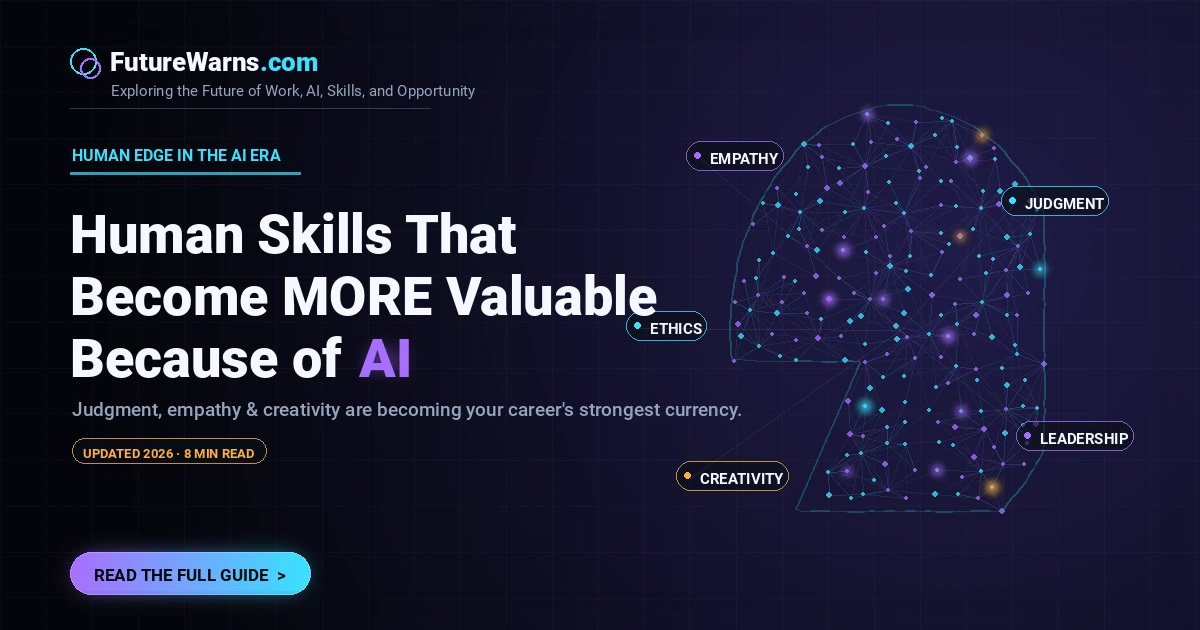
In 2013, a radiologist’s job looked automation-proof for maybe another decade. By 2023, AI models were reading scans as accurately as trained specialists in several studies. And yet — radiologists aren’t disappearing. The ones thriving today aren’t the ones who read images fastest. They’re the ones who can walk into a room, tell a frightened patient what a shadow on their lung actually means, and decide what to do next. That’s the twist nobody saw coming: the more powerful AI gets, the more it exposes which human skills were never really about the task at all.
Introduction: The Myth of the Robot Takeover
Every few years, a new technology sparks the same headline: “Robots Are Coming for Your Job.” ATMs were supposed to end bank tellers. Spreadsheets were supposed to end accountants. Now it’s generative AI, and the panic feels louder because, this time, the machine can write, design, code, and talk back.
But something interesting is happening underneath the noise. Employers aren’t just asking “which jobs will AI replace.” They’re asking “which human capabilities are we not investing in enough — and which ones just became existential.” According to the World Economic Forum, employers anticipate that 39% of core workplace skills will change by 2030, and businesses are already scrambling to close that gap through reskilling.
This article isn’t another AI-doom piece. It’s a practical, evidence-based map of exactly which human skills are becoming more valuable because of AI — not despite it — and what you can do, starting this month, to build them.
- Why AI Makes Certain Human Skills More Valuable, Not Less
- The 10 Human Skills Rising in Value Because of AI
- Comparison Table: AI Strengths vs. Human Strengths
- Real-World Case Studies
- Common Mistakes People Make
- How to Build These Skills: A Step-by-Step Guide
- Future Predictions: 2026–2030
- Quick Checklist: Are You AI-Resilient?
- FAQ
- Key Takeaways
Why AI Makes Certain Human Skills More Valuable, Not Less
Think of AI as an extremely capable intern who never sleeps, never forgets, and can draft a report in nine seconds — but has never had a bad day, never lost a client’s trust, and has no idea when a “correct” answer is still the wrong move. That gap is exactly where human value now concentrates.
Economists call this the “complementarity effect.” When a technology automates one part of a job, the remaining human tasks don’t shrink in value — they grow, because they become the bottleneck. LinkedIn’s Chief Economist noted that people today are more than twice as likely to add AI skills to their profiles than in 2018, and yet the paradox is that this very shift is pushing human-centric skills higher up the priority list, not lower.
There’s a second reason, too: trust. AI-generated content and decisions are now so common that authenticity itself has become scarce — and scarcity drives value. A handwritten thank-you note stands out more in an age of auto-generated emails. A leader who makes a hard call and owns it stands out more in an age of algorithmic recommendations nobody can quite explain.
The 10 Human Skills Rising in Value Because of AI
1. Judgment and Decision-Making Under Uncertainty
AI is excellent at pattern-matching against historical data. It is far weaker when a situation is genuinely novel, ambiguous, or carries competing values with no “correct” answer. A hiring manager deciding between two equally qualified candidates, a doctor weighing quality of life against treatment risk, a founder deciding whether to pivot — these require weighing incomplete information against consequences a model has never lived through.
Judgment isn’t about knowing more facts. It’s about knowing which facts matter right now, for this person, in this context.
2. Empathy and Emotional Intelligence
Nurses, therapists, teachers, and customer support leads aren’t being replaced by AI — they’re being freed from paperwork so they can spend more time on the part of the job that actually required a human in the first place. The World Economic Forum’s human-centric skills research flags empathy and active listening as critical for leadership, healthcare, customer service, and team cohesion, precisely because no chatbot can sit with someone in genuine distress and make them feel heard.
3. Creative Synthesis (Not Just Creativity)
AI can generate a thousand variations of an image or a paragraph in seconds. What it can’t do is know which one actually serves a specific brand, culture, or moment — and why. The valuable creative skill now isn’t “can you make something,” it’s “can you curate, combine, and contextualize” — pulling ideas from unrelated fields and fusing them into something that resonates with actual humans.
4. Complex, High-Stakes Communication
Delivering bad news to a client. De-escalating an angry customer. Persuading a skeptical board. These require reading a room, adjusting tone in real time, and holding space for someone else’s reaction — skills that remain stubbornly human even as AI drafts our emails.
5. Adaptability and Learning Agility
The half-life of a technical skill keeps shrinking. The WEF explicitly lists resilience, flexibility and agility as skills that are not only critical now but projected to become even more important by 2030. The people thriving aren’t the ones who know the most today — they’re the ones who can relearn the fastest tomorrow.
6. Ethical Reasoning and Accountability
Someone has to be responsible when an AI system makes a biased hiring recommendation or a flawed medical suggestion. That “someone” is a human who can reason through fairness, context, and consequence — and who can be held accountable in a way a model cannot.
7. Systems Thinking
AI is powerful within a narrow, well-defined task. It struggles to see how a decision in marketing ripples into supply chain, legal exposure, and customer trust simultaneously. The WEF’s skills outlook names systems thinking among the capabilities solidifying their importance as organizations grow more complex and interconnected.
8. Leadership and Social Influence
Rallying a team through uncertainty, building trust across a merger, motivating people through a layoff round — these require a human presence. The Future of Jobs Report 2025 places leadership and social influence among the top ten skills rising in importance globally.
9. Curiosity and Lifelong Learning
The willingness to keep asking “why” and “what if” is what determines whether someone uses AI as a crutch or a lever. The WEF notes this is one of the fastest-rising skills — yet also one of the weakest in supply, with 59% of the global workforce needing reskilling by 2030 according to their estimates.
10. Asking the Right Question (Prompting as a Meta-Skill)
This is new, and it’s easy to underestimate. The quality of an AI’s output is bound entirely by the quality of the human’s question. Knowing what to ask — and knowing when the AI’s answer is subtly wrong — has become its own professional skill, closer to editorial judgment than typing.
Comparison Table: AI Strengths vs. Human Strengths
| Capability | AI’s Strength | Where Humans Still Win |
|---|---|---|
| Speed | Processes vast data in seconds | Deciding what’s worth processing at all |
| Consistency | Never tired, never inconsistent | Adapting tone/approach to a unique person |
| Pattern Recognition | Finds patterns across millions of data points | Recognizing when a pattern shouldn’t apply |
| Content Generation | Drafts, summarizes, codes instantly | Knowing which draft actually fits the moment |
| Emotional Connection | Simulates empathy in language | Genuine trust, accountability, shared experience |
| Ethics & Accountability | Can flag rules, not weigh values | Owning consequences of a judgment call |
Pros & Cons of Leaning Into Human-Centric Skills
| Pros | Cons |
|---|---|
| Harder for AI or outsourcing to displace | Slower to measure and credential than technical skills |
| Compounds with experience over a career | Requires sustained practice, not a one-time course |
| Increases trust and leadership potential | Payoff can be less immediate than a technical certification |
Real-World Case Studies
Case Study 1: Customer Support at Scale
Many large companies now route routine queries — password resets, order tracking — entirely through AI chatbots. What’s left for human agents are the emotionally charged, ambiguous, or high-value cases: an angry customer after a failed surgery-adjacent product, a business client renegotiating a contract. Support teams that invested in de-escalation training and emotional intelligence report higher retention of exactly the customers most likely to churn.
Case Study 2: Radiology and Diagnostic Medicine
AI models can flag anomalies in scans with high accuracy, and several peer-reviewed studies have shown AI matching or exceeding human accuracy on narrow detection tasks. Yet demand for radiologists hasn’t collapsed — their role has shifted toward interpreting ambiguous or borderline cases, communicating findings to patients, and integrating imaging with a patient’s full clinical picture, none of which the model does end-to-end.
Case Study 3: Journalism and Content
Newsrooms use AI to draft earnings summaries and sports recaps. The journalists who remain valuable are the ones doing investigative work, building sources, and exercising editorial judgment about what’s newsworthy and true — precisely the parts of journalism that require trust built over years, not seconds.
Common Mistakes People Make
How to Build These Skills: A Step-by-Step Guide
Step 1: Audit Your Current Role
List every task you do in a typical week. Mark each as “repeatable” (AI can likely do this soon) or “judgment-based” (requires context, relationships, or accountability). This tells you exactly where to invest your development time.
Step 2: Practice Deliberate Empathy
In your next five difficult conversations, pause before responding and name the other person’s likely emotion out loud, even just to yourself. This single habit measurably improves emotional intelligence over a few months of consistent practice.
Step 3: Seek Ambiguous Problems on Purpose
Volunteer for the messy project nobody wants — the one without a clear spec. Judgment only develops by making decisions with incomplete information and living with the outcome.
Step 4: Learn to Direct AI, Not Just Use It
Practice writing precise prompts, then critically evaluating the output for gaps, bias, or subtle errors. This “AI supervision” skill is becoming a hiring differentiator across industries.
Step 5: Build a Feedback Loop
Ask a mentor or colleague to rate your communication, leadership, or judgment quarterly. Durable skills only compound if you can see whether they’re actually improving.
Step 6: Teach What You Know
Explaining a concept to someone else is one of the fastest ways to deepen judgment and communication skills simultaneously — and it builds the kind of reputation an algorithm can’t replicate.
Future Predictions: 2026–2030
- Hybrid roles will dominate. Expect more job titles that pair a technical AI-fluency requirement with a human-centric core — “AI-augmented nurse,” “AI-literate financial advisor.”
- Credentialing for soft skills will mature. Expect more formal assessments and certifications for judgment, communication, and adaptability, closing today’s measurement gap.
- Trust becomes a premium service. Businesses that can prove a human reviewed, verified, or stands behind AI-assisted work will command higher prices — much like “organic” or “handmade” labeling in other markets.
- The skills gap will widen before it narrows. With 1.4 million unfilled tech positions and a projected global shortage of 11 million healthcare workers by 2030 cited in recent workforce research, the pressure to reskill toward durable human capabilities will only intensify.
Quick Checklist: Are You AI-Resilient?
- ☐ I can explain, in plain language, why I made a recent decision — not just what I decided.
- ☐ I’ve had a difficult conversation this month and handled it without avoiding it.
- ☐ I regularly question AI-generated outputs before using them.
- ☐ I’ve learned a genuinely new skill or tool in the last six months.
- ☐ People come to me for judgment calls, not just information.
- ☐ I can explain a complex idea to a non-expert clearly.
If you checked fewer than four boxes, treat Step 1 through Step 6 above as your next 90-day plan.
Limitations and Honest Caveats
It’s worth being upfront: not every job will have room for these skills to matter equally, and transitions will be uneven across regions and industries. Some roles genuinely will shrink faster than new human-centric demand can absorb displaced workers, and reskilling takes time, resources, and access that not everyone has equally. The data cited here reflects large-scale employer surveys and economic research current as of 2025, and projections — especially anything dated beyond 2026 — should be treated as informed estimates, not certainties.
“We are not just in a cyclical skills shortage but a structural one.” — World Economic Forum, 2025
Frequently Asked Questions
Will AI eventually replace human skills like empathy or judgment too?
Uncertain, and reasonable experts disagree. Current AI can simulate empathetic language convincingly, but simulating a response and genuinely being accountable for a decision’s human consequences remain different things. Most economic forecasts through 2030 do not project full replacement of judgment-heavy, relationship-based roles.
Which industries need these human skills most urgently?
Healthcare, education, leadership and management, customer-facing roles, and any field involving high-stakes or ethically complex decisions — law, finance advisory, HR, and journalism among them.
Can I develop emotional intelligence at any age or career stage?
Yes. Unlike some technical skills with steep learning curves, emotional intelligence and judgment improve through consistent practice and feedback at any career stage — there’s no cutoff.
Is learning to use AI tools itself a “human skill”?
Directing AI effectively — prompting, evaluating, and correcting its output — is increasingly considered its own professional competency, sitting at the intersection of technical literacy and judgment.
How do I convince my employer to invest in these skills, not just AI tools?
Point to the WEF’s own findings: employers already rank resilience, flexibility, and leadership among the fastest-growing skills right alongside AI and cybersecurity. This isn’t a values argument — it’s a competitiveness argument.
Key Takeaways
- AI is automating tasks, not the human relationships and judgment surrounding them.
- Empathy, judgment, adaptability, ethical reasoning, and complex communication are rising in market value, not falling.
- Employers explicitly want AI literacy paired with human-centric skills — not one instead of the other.
- These skills are trainable through deliberate practice, not fixed personality traits.
- The biggest risk isn’t AI replacing you — it’s failing to invest in the skills AI can’t replace.
Suggested Reading on FutureWarns
- Read more: What Is AI Literacy and Why Every Professional Needs It
- Read more: Jobs AI Is Unlikely to Replace Before 2030
- Read more: A Practical Guide to Building Emotional Intelligence at Work
- Read more: Future of Work 2030 — Key Trends You Can’t Ignore
- Read more: How to Reskill for the AI Economy Without Quitting Your Job
Authoritative External Sources
- World Economic Forum — Future of Jobs Report 2025
- World Economic Forum — AI is shifting the workplace skillset, but human skills still count
- OECD — Skills for Jobs
- LinkedIn Economic Graph — Workforce Insights
Want to stay ahead of the AI curve? Explore more practical, research-backed guides on the skills, tools, and trends shaping your career at Futurewarns.com.