By the FutureWarns Cybersecurity Desk · Updated September 2026 · Reviewed against FBI, FTC, and industry fraud reports
Three seconds of your voice. That’s all it takes for a scammer to build a clone convincing enough to fool your own parents. This isn’t science fiction — it happened to thousands of families last year alone. Let us discuss – How AI Makes Online Scams More Convincing and How to Protect Yourself.
Why This Topic Matters Right Now
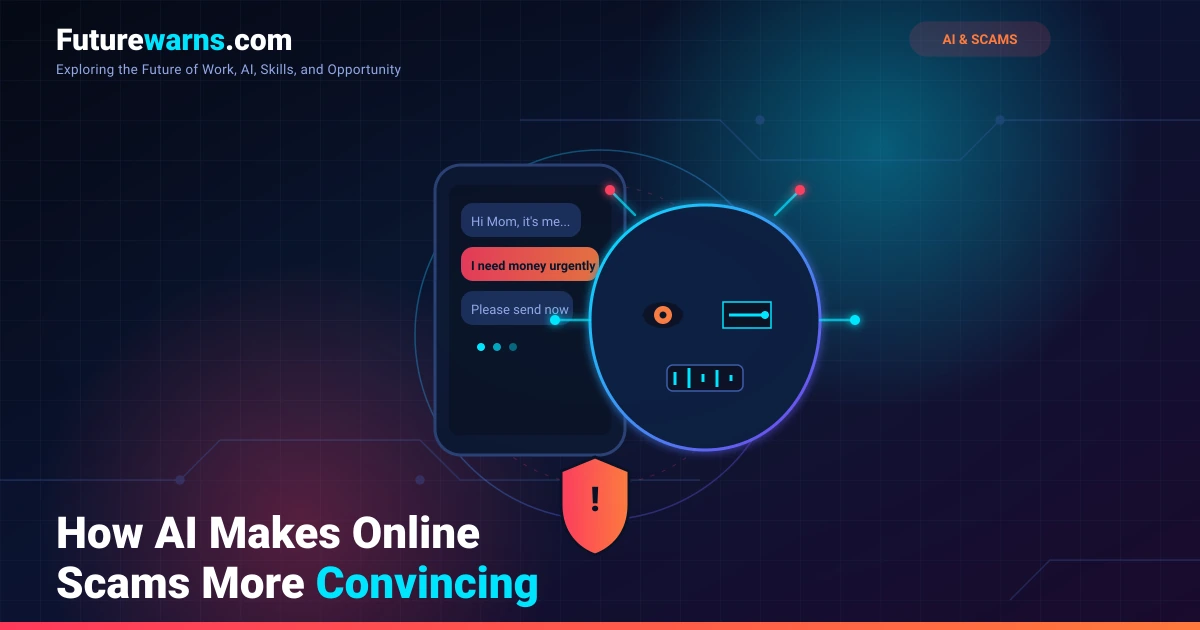
Picture this: your phone rings at 11 p.m. It’s your daughter’s voice, panicked, saying she’s been in an accident and needs bail money right now. Except your daughter is asleep in her room. The voice on the phone was built from a 12-second video clip she posted last month.
This exact scenario has played out thousands of times across the world in the past year. It isn’t a rare, isolated case — it has become a repeatable playbook that criminal groups run at scale, the same way a call centre runs a sales script. The only difference is that the “employees” are AI models, and they never get tired, never sound nervous, and never make a typo.
For years, we were taught to spot scams by looking for sloppiness — broken English, blurry logos, a robotic voice on the other end of the line. That advice is now outdated. Generative AI has closed almost every gap that used to give scammers away. This article breaks down exactly how that happened, what it looks like in practice, and — most importantly — a practical, step-by-step system to protect yourself, your family, and your business, based on guidance from the FBI, FTC, CISA, and independent fraud researchers.
- The Problem: What Changed
- AI Scam Statistics You Need to Know (2025–2026)
- How AI Actually Makes Scams More Convincing
- Anatomy of an AI-Powered Scam (Flow Chart)
- The Main Types of AI-Enabled Scams
- Real Case Study: The $25.6 Million Deepfake Call
- Who’s Most at Risk
- The Practical Solution: A Verification-First Mindset
- Step-by-Step: What to Do If You Suspect a Scam
- Tools That Actually Help
- Common Mistakes People Make
- Future Outlook: Where This Is Heading
- FAQ
- Key Takeaways
1. The Problem: What Changed
Traditional scams relied on volume. Send a million badly written emails, hope a few hundred people fall for it. The economics worked because sending emails is nearly free, even when the success rate is tiny.
Generative AI broke that trade-off. Scammers can now send a million emails that are each individually well-written, personalized, and free of the grammar mistakes that used to trip a spam filter or a suspicious reader. Large language models can read someone’s public profile and recent posts, then write a message that references real details about that person’s life — their job title, their manager’s name, their recent trip. Voice-cloning tools can turn a short public video into a synthetic voice you’d swear was real. Deepfake video tools can put a real person’s face onto a live video call.
The result is a completely different threat landscape. Security researchers put it simply: the old tells are gone. You can no longer spot a scam by looking for sloppiness — you have to spot it by changing how you verify.
2. AI Scam Statistics You Need to Know (2025–2026)
Numbers make this real. Here’s what official and industry data currently shows. Where sources differ slightly on methodology, we’ve noted it — nobody has a perfect count, mainly because most victims never report what happened to them.
| Metric | Figure | Source |
|---|---|---|
| AI-linked fraud losses reported to FBI IC3 (2025) | $893,346,472 across 22,364 complaints | FBI Internet Crime Complaint Center |
| Surge in AI-enabled scams (2025 vs. prior year) | 1,210% increase | Enterprise security monitoring / Vectra AI |
| Audio needed to clone a voice | As little as roughly 3 seconds of clear speech | Voice-cloning vendors and security researchers |
| Global scam losses (all types), 2024 | Estimated at $442 billion worldwide | Global fraud reporting bodies |
| Projected global AI scam losses by 2027 | Could reach $40 billion | Industry fraud forecasts |
| People who correctly identify a cloned voice as fake | About 60% of the time — barely better than chance | Barrington & Cooper, Nature Scientific Reports, 2025 |
| Listeners who perceive a cloned voice as the same person | Roughly 80% of the time | Same study |
| Share of victims who report voice-clone fraud | Estimated at under 5% | Congressional researchers |
| Losses traced to social-media data harvesting | $2.1 billion in 2025, an eightfold jump since 2020 | FTC consumer alerts, 2026 |
A note on the data: Different reports use different definitions of “AI scam,” and underreporting is a well-documented problem — one industry report found that only around 15% of victims report these crimes to authorities, often out of embarrassment. So treat every figure above as a floor, not a ceiling. The direction of the trend is what matters most, and every credible source agrees it’s moving sharply upward.
3. How AI Actually Makes Scams More Convincing
Let’s get specific. Here are the actual technical tricks being used, not vague “AI is scary” talk.
3.1 Voice cloning removes the “it doesn’t sound like them” defense
Modern voice-cloning models can build a convincing replica of someone’s voice, including their accent, tone, and speech patterns, from a very short sample. That sample can come from a voicemail greeting, a podcast appearance, a short video clip, or even a wrong-number call where the scammer simply gets you talking for a few seconds. Once they have it, they can type any sentence and have it read back in that voice.
3.2 Deepfake video defeats “let’s hop on a video call to confirm”
For years, “let’s do a video call so I can see your face” was decent advice. Real-time face-swapping tools have weakened that advice considerably. In a widely reported case involving the engineering firm Arup, an employee joined a video call believing he was speaking with his company’s CFO and several colleagues. Every face and voice on that call turned out to be an AI-generated deepfake, and by the time the fraud was discovered, the employee had transferred $25.6 million across 15 separate transactions.
3.3 Large language models write phishing messages with zero red flags
Grammar mistakes, awkward phrasing, and generic greetings used to be the easiest way to spot a phishing email. Language models now write fluent, personalized, context-aware messages, which is exactly why security teams report that AI-powered phishing attacks lack the telltale signs that older email filters were trained to catch.
3.4 AI scrapes your public data to personalize the attack
Scammers don’t need to guess anymore. They can feed your public social media posts, job title, and location into an AI tool and get back a tailored script that references real details, which makes the approach feel personal and legitimate instead of like a mass blast.
3.5 Automated, always-on scam operations
AI-powered scam call centres now combine synthetic voices with automated conversation scripts, letting a single operation run over a thousand scam calls a day against major companies — a scale that would have required a large human workforce just a few years ago.
4. Anatomy of an AI-Powered Scam (Flow Chart)
Here’s how a typical AI-enabled impersonation scam unfolds, step by step, so you can recognize the pattern instead of trying to spot a “fake voice” in the moment.
Notice that AI only does the “convincing” part — steps 1 through 3. Steps 4 through 7 are the same social-engineering playbook criminals have used for decades: urgency, secrecy, and a payment method that’s hard to trace. That’s actually good news, because it means the defenses that already worked against classic scams — verify independently, slow down, never pay in gift cards or crypto on demand — still work here too.
5. The Main Types of AI-Enabled Scams
| Scam Type | How AI Is Used | Typical Target |
|---|---|---|
| Family emergency / “grandparent scam” | Cloned voice of a relative claiming to be in trouble | Elderly parents and grandparents |
| Executive impersonation (CEO fraud) | Cloned voice or deepfake video of a boss authorizing a wire transfer | Finance and accounts teams |
| Romance scams | AI-generated photos and chatbots that sustain long, emotionally convincing conversations | Adults on dating apps |
| Investment and crypto scams | Deepfake videos of celebrities or officials “endorsing” a platform | General public, retirees |
| Phishing emails and texts | Language-model-written, personalized, grammatically flawless messages | Anyone with an email address or phone |
| Fake job offers / fraudulent recruiters | Deepfake video candidates or AI-generated recruiter personas | Job seekers, HR teams |
| Government impersonation | Cloned voices of officials, AI-generated robocalls | General public |
6. Real Case Study: The $25.6 Million Deepfake Call
This is one of the most cited examples in fraud research, and it’s worth understanding in detail because it shows how far the deception can go.
Why it worked: The attackers didn’t just fake one voice — they faked an entire meeting, exploiting the natural trust we place in “seeing is believing.” There was no single point of failure to catch, because every participant appeared to independently confirm the request.
The lesson: A video call is no longer sufficient proof of identity on its own, especially for high-value financial decisions. Organizations now need a secondary, independent verification channel — such as calling back on a known number or requiring dual sign-off through a separate system — before large transfers go out.
7. Who’s Most at Risk
- Elderly parents and grandparents — often targeted with cloned voices of grandchildren in fake emergencies. Researchers have noted that scam success rates have climbed as the cloning technology has improved.
- Finance and accounts payable teams — a single cloned “urgent wire transfer” call can bypass normal checks if there’s no independent verification step in place.
- People who post a lot of voice or video content publicly — the more audio and video of you that’s public, the easier you are to clone. One industry estimate found that more than half of people share voice recordings online at least once a week.
- Job seekers and HR recruiters — fake AI-generated candidates and recruiter personas are now a documented tactic.
- Small businesses without a verification policy — larger companies increasingly have callback protocols in place; smaller teams often don’t.
8. The Practical Solution: A Verification-First Mindset
You cannot reliably detect an AI fake by ear or by eye anymore — the research above makes that clear. So the entire defense has to shift from “detect the fake” to “verify the request through a separate, trusted channel, every single time it involves money, credentials, or urgency.”
Build a “family safe word”
Agree on a private code word with close family members that you’d only ever share in person. If someone calls claiming to be them in an emergency, ask for the word. An AI clone won’t know it, and this defeats the scam instantly — no technical skill required.
Treat urgency itself as a red flag
Every version of this scam — old or new — relies on rushing you before you can think clearly. If a request insists you skip your normal verification steps because there’s “no time,” that pressure is the scam, not a side effect of it.
9. Step-by-Step: What to Do If You Suspect a Scam
- Stop and disengage. Hang up the call, don’t reply to the message, and don’t click any link it contains.
- Verify independently. Call the person or organization back using a number you already had saved — not one provided in the suspicious message.
- Do not send money or codes while you’re still on the original call or chat, no matter how convincing or urgent it sounds.
- Check for the payment red flag. Gift cards, wire transfers, and cryptocurrency are the top three payment methods scammers push, because they’re nearly impossible to reverse.
- Document everything. Save the phone number, screenshots, email headers, and any audio if possible.
- Report it. In the US, file with the FBI’s Internet Crime Complaint Center at ic3.gov for wire fraud or deepfake fraud, and with the FTC at reportfraud.ftc.gov for imposter and voice-cloning scams. Outside the US, use your country’s national cybercrime reporting agency.
- Alert your bank immediately if a payment was made — faster reporting significantly increases the chance of a reversal or freeze.
- Tell your family or team. If it happened to you, it’s likely being tried on others in your circle too — a quick warning can stop the next attempt.
10. Tools That Actually Help
| Tool / Practice | What It Does | Best For |
|---|---|---|
| Callback verification | Confirms identity via a known, separate number | Everyone — free and highly effective |
| Family safe word | A shared secret that AI clones can’t know | Families, especially with elderly relatives |
| Dual sign-off for wire transfers | Requires a second, independent approver for large payments | Businesses and finance teams |
| STIR/SHAKEN caller ID authentication | A telecom-level protocol that helps block spoofed phone numbers before they reach you | Consumers (enabled by carriers) |
| Reverse image and voice search tools | Helps confirm whether a profile photo or clip is stolen or reused elsewhere | Dating app users, recruiters |
| Social media privacy settings | Limits how much voice and video content is publicly scrapeable | Anyone who posts video or voice content |
11. Common Mistakes People Make
- Trusting caller ID. Numbers can be spoofed to look exactly like a real contact or organization.
- Assuming “I’d know my own child’s or spouse’s voice.” Research shows people misidentify cloned voices as real roughly 80% of the time — confidence is not protection.
- Reacting instead of pausing. Even a 60-second pause to call back on a known number breaks almost every version of this scam.
- Not reporting out of embarrassment. Underreporting means fraud patterns stay hidden longer, which helps scammers, not victims. Feeling foolish is common, but it isn’t a reason to stay silent — reporting helps protect others too.
- Relying on “listen for a robotic tone.” That advice is outdated; modern AI-generated audio and video can look and sound fully convincing, so it shouldn’t be your primary defense.
- Skipping verification because “it sounded exactly right.” The more accurate the clone, the more this step matters, not less.
12. Future Outlook: Where This Is Heading
The honest answer is that this problem will likely get worse before it gets better, but there are real countermeasures being built on multiple fronts.
- Regulation is catching up. The FTC has proposed rules that would let it directly seek monetary relief from scammers who use AI to impersonate individuals, and is examining whether AI platforms themselves could bear responsibility if they knowingly enable impersonation-based harm.
- Telecom-level defenses are expanding. Providers are rolling out call-authentication protocols designed to block spoofed calls before they ever reach your phone.
- AI companies are adding guardrails. Major voice-model providers have introduced stricter internal safeguards on their voice-cloning tools, though independent testing has found several major consumer voice-cloning tools still lack meaningful misuse safeguards — so this fix is partial, not complete.
- Detection technology is a moving target. As detection tools improve, so does the sophistication of the scams designed to beat them — expect this to remain an arms race rather than a solved problem.
- Verification culture is becoming the real defense. The most durable fix isn’t a piece of software — it’s a habit: independent verification before acting on any urgent request involving money or sensitive data. That habit doesn’t expire when the next AI model comes out.
Our take, clearly separated from the facts above: personal verification habits — like safe words and callback rules — will likely remain more reliable for individuals than any detection app for the next few years, simply because the technology used to generate convincing fakes is improving faster than the technology used to detect them.
Frequently Asked Questions
Not reliably. Peer-reviewed research found people correctly spotted an AI-generated voice as fake only about 60% of the time — barely better than a coin flip. Don’t rely on your ear alone; use independent verification instead.
Current voice-cloning systems can produce a convincing clone from roughly three seconds of clear speech — a voicemail greeting or a short social media clip is enough.
Contact your bank or payment provider immediately to attempt a reversal or freeze, then report it to the FBI’s IC3 (ic3.gov) or FTC (reportfraud.ftc.gov) if you’re in the US, or your country’s equivalent cybercrime authority. Speed matters — the sooner you report, the higher the chance of recovering funds.
Both, but for different reasons. Individuals — especially elderly relatives — are targeted through emotional, family-emergency scenarios. Businesses are targeted through executive impersonation aimed at large wire transfers, as shown in the Arup case above.
You don’t need to stop entirely, but be aware that public voice and video content is exactly what’s used to build clones. Consider limiting public visibility of close family members, especially elderly relatives, and agree on a family safe word as a backup defense.
Key Takeaways
- AI hasn’t invented new scams — it has removed the warning signs that used to help us catch old ones.
- Voice clones need as little as 3 seconds of audio, and humans misidentify them as real most of the time.
- The single best defense is independent verification: call back on a number you already have, not one given to you in the moment.
- A family safe word and a business dual-approval rule for wire transfers stop the vast majority of these scams cold.
- Report every incident — underreporting is currently hiding the true scale of the problem.
Read More on FutureWarns
- How to Spot a Deepfake Video in 2026: A Practical Checklist
- AI-Written Phishing Emails: Why They’re Harder to Catch Now
- How to Protect Elderly Parents From Online and Phone Scams
- Wire Transfer Fraud Prevention: A Checklist for Small Businesses
- AI Regulation 101: What the FTC’s New Rules Mean for You
Sources
- FBI Internet Crime Complaint Center (IC3) — 2025 AI-related fraud data
- Federal Trade Commission — Voice Cloning Consumer Guidance and proposed AI impersonation rules
- CISA — Phishing prevention guidance
- Barrington & Cooper, “Deepfake voice detection study,” Nature Scientific Reports, 2025
- Vectra AI — “AI Scams in 2026: How They Work and How to Detect Them”
- Reported case coverage of the Arup deepfake video call fraud
Disclaimer: This article is for informational purposes and reflects publicly available data as of September 2026. Fraud statistics vary by source and are likely undercounted due to low victim reporting rates. This is not legal or financial advice — if you’ve lost money to a scam, contact your bank and a relevant law enforcement or consumer protection agency directly.
Generative AI broke that trade-off. Scammers can now send a million emails that are each individually well-written, personalized, and free of the grammar mistakes that used to trip a spam filter or a suspicious reader. Large language models can read someone’s public profile and recent posts, then write a message that references real details about that person’s life — their job title, their manager’s name, their recent trip. Voice-cloning tools can turn a short public video into a synthetic voice you’d swear was real. Deepfake video tools can put a real person’s face onto a live video call.
The result is a completely different threat landscape. Security researchers put it simply: the old tells are gone. You can no longer spot a scam by looking for sloppiness — you have to spot it by changing how you verify.
2. AI Scam Statistics You Need to Know (2025–2026)
Numbers make this real. Here’s what official and industry data currently shows. Where sources differ slightly on methodology, we’ve noted it — nobody has a perfect count, mainly because most victims never report what happened to them.
| Metric | Figure | Source |
|---|---|---|
| AI-linked fraud losses reported to FBI IC3 (2025) | $893,346,472 across 22,364 complaints | FBI Internet Crime Complaint Center |
| Surge in AI-enabled scams (2025 vs. prior year) | 1,210% increase | Enterprise security monitoring / Vectra AI |
| Audio needed to clone a voice | As little as roughly 3 seconds of clear speech | Voice-cloning vendors and security researchers |
| Global scam losses (all types), 2024 | Estimated at $442 billion worldwide | Global fraud reporting bodies |
| Projected global AI scam losses by 2027 | Could reach $40 billion | Industry fraud forecasts |
| People who correctly identify a cloned voice as fake | About 60% of the time — barely better than chance | Barrington & Cooper, Nature Scientific Reports, 2025 |
| Listeners who perceive a cloned voice as the same person | Roughly 80% of the time | Same study |
| Share of victims who report voice-clone fraud | Estimated at under 5% | Congressional researchers |
| Losses traced to social-media data harvesting | $2.1 billion in 2025, an eightfold jump since 2020 | FTC consumer alerts, 2026 |
A note on the data: Different reports use different definitions of “AI scam,” and underreporting is a well-documented problem — one industry report found that only around 15% of victims report these crimes to authorities, often out of embarrassment. So treat every figure above as a floor, not a ceiling. The direction of the trend is what matters most, and every credible source agrees it’s moving sharply upward.
3. How AI Actually Makes Scams More Convincing
Let’s get specific. Here are the actual technical tricks being used, not vague “AI is scary” talk.
3.1 Voice cloning removes the “it doesn’t sound like them” defense
Modern voice-cloning models can build a convincing replica of someone’s voice, including their accent, tone, and speech patterns, from a very short sample. That sample can come from a voicemail greeting, a podcast appearance, a short video clip, or even a wrong-number call where the scammer simply gets you talking for a few seconds. Once they have it, they can type any sentence and have it read back in that voice.
3.2 Deepfake video defeats “let’s hop on a video call to confirm”
For years, “let’s do a video call so I can see your face” was decent advice. Real-time face-swapping tools have weakened that advice considerably. In a widely reported case involving the engineering firm Arup, an employee joined a video call believing he was speaking with his company’s CFO and several colleagues. Every face and voice on that call turned out to be an AI-generated deepfake, and by the time the fraud was discovered, the employee had transferred $25.6 million across 15 separate transactions.
3.3 Large language models write phishing messages with zero red flags
Grammar mistakes, awkward phrasing, and generic greetings used to be the easiest way to spot a phishing email. Language models now write fluent, personalized, context-aware messages, which is exactly why security teams report that AI-powered phishing attacks lack the telltale signs that older email filters were trained to catch.
3.4 AI scrapes your public data to personalize the attack
Scammers don’t need to guess anymore. They can feed your public social media posts, job title, and location into an AI tool and get back a tailored script that references real details, which makes the approach feel personal and legitimate instead of like a mass blast.
3.5 Automated, always-on scam operations
AI-powered scam call centres now combine synthetic voices with automated conversation scripts, letting a single operation run over a thousand scam calls a day against major companies — a scale that would have required a large human workforce just a few years ago.
4. Anatomy of an AI-Powered Scam (Flow Chart)
Here’s how a typical AI-enabled impersonation scam unfolds, step by step, so you can recognize the pattern instead of trying to spot a “fake voice” in the moment.
Notice that AI only does the “convincing” part — steps 1 through 3. Steps 4 through 7 are the same social-engineering playbook criminals have used for decades: urgency, secrecy, and a payment method that’s hard to trace. That’s actually good news, because it means the defenses that already worked against classic scams — verify independently, slow down, never pay in gift cards or crypto on demand — still work here too.
5. The Main Types of AI-Enabled Scams
| Scam Type | How AI Is Used | Typical Target |
|---|---|---|
| Family emergency / “grandparent scam” | Cloned voice of a relative claiming to be in trouble | Elderly parents and grandparents |
| Executive impersonation (CEO fraud) | Cloned voice or deepfake video of a boss authorizing a wire transfer | Finance and accounts teams |
| Romance scams | AI-generated photos and chatbots that sustain long, emotionally convincing conversations | Adults on dating apps |
| Investment and crypto scams | Deepfake videos of celebrities or officials “endorsing” a platform | General public, retirees |
| Phishing emails and texts | Language-model-written, personalized, grammatically flawless messages | Anyone with an email address or phone |
| Fake job offers / fraudulent recruiters | Deepfake video candidates or AI-generated recruiter personas | Job seekers, HR teams |
| Government impersonation | Cloned voices of officials, AI-generated robocalls | General public |
6. Real Case Study: The $25.6 Million Deepfake Call
This is one of the most cited examples in fraud research, and it’s worth understanding in detail because it shows how far the deception can go.
Why it worked: The attackers didn’t just fake one voice — they faked an entire meeting, exploiting the natural trust we place in “seeing is believing.” There was no single point of failure to catch, because every participant appeared to independently confirm the request.
The lesson: A video call is no longer sufficient proof of identity on its own, especially for high-value financial decisions. Organizations now need a secondary, independent verification channel — such as calling back on a known number or requiring dual sign-off through a separate system — before large transfers go out.
7. Who’s Most at Risk
- Elderly parents and grandparents — often targeted with cloned voices of grandchildren in fake emergencies. Researchers have noted that scam success rates have climbed as the cloning technology has improved.
- Finance and accounts payable teams — a single cloned “urgent wire transfer” call can bypass normal checks if there’s no independent verification step in place.
- People who post a lot of voice or video content publicly — the more audio and video of you that’s public, the easier you are to clone. One industry estimate found that more than half of people share voice recordings online at least once a week.
- Job seekers and HR recruiters — fake AI-generated candidates and recruiter personas are now a documented tactic.
- Small businesses without a verification policy — larger companies increasingly have callback protocols in place; smaller teams often don’t.
8. The Practical Solution: A Verification-First Mindset
You cannot reliably detect an AI fake by ear or by eye anymore — the research above makes that clear. So the entire defense has to shift from “detect the fake” to “verify the request through a separate, trusted channel, every single time it involves money, credentials, or urgency.”
Build a “family safe word”
Agree on a private code word with close family members that you’d only ever share in person. If someone calls claiming to be them in an emergency, ask for the word. An AI clone won’t know it, and this defeats the scam instantly — no technical skill required.
Treat urgency itself as a red flag
Every version of this scam — old or new — relies on rushing you before you can think clearly. If a request insists you skip your normal verification steps because there’s “no time,” that pressure is the scam, not a side effect of it.
9. Step-by-Step: What to Do If You Suspect a Scam
- Stop and disengage. Hang up the call, don’t reply to the message, and don’t click any link it contains.
- Verify independently. Call the person or organization back using a number you already had saved — not one provided in the suspicious message.
- Do not send money or codes while you’re still on the original call or chat, no matter how convincing or urgent it sounds.
- Check for the payment red flag. Gift cards, wire transfers, and cryptocurrency are the top three payment methods scammers push, because they’re nearly impossible to reverse.
- Document everything. Save the phone number, screenshots, email headers, and any audio if possible.
- Report it. In the US, file with the FBI’s Internet Crime Complaint Center at ic3.gov for wire fraud or deepfake fraud, and with the FTC at reportfraud.ftc.gov for imposter and voice-cloning scams. Outside the US, use your country’s national cybercrime reporting agency.
- Alert your bank immediately if a payment was made — faster reporting significantly increases the chance of a reversal or freeze.
- Tell your family or team. If it happened to you, it’s likely being tried on others in your circle too — a quick warning can stop the next attempt.
10. Tools That Actually Help
| Tool / Practice | What It Does | Best For |
|---|---|---|
| Callback verification | Confirms identity via a known, separate number | Everyone — free and highly effective |
| Family safe word | A shared secret that AI clones can’t know | Families, especially with elderly relatives |
| Dual sign-off for wire transfers | Requires a second, independent approver for large payments | Businesses and finance teams |
| STIR/SHAKEN caller ID authentication | A telecom-level protocol that helps block spoofed phone numbers before they reach you | Consumers (enabled by carriers) |
| Reverse image and voice search tools | Helps confirm whether a profile photo or clip is stolen or reused elsewhere | Dating app users, recruiters |
| Social media privacy settings | Limits how much voice and video content is publicly scrapeable | Anyone who posts video or voice content |
11. Common Mistakes People Make
- Trusting caller ID. Numbers can be spoofed to look exactly like a real contact or organization.
- Assuming “I’d know my own child’s or spouse’s voice.” Research shows people misidentify cloned voices as real roughly 80% of the time — confidence is not protection.
- Reacting instead of pausing. Even a 60-second pause to call back on a known number breaks almost every version of this scam.
- Not reporting out of embarrassment. Underreporting means fraud patterns stay hidden longer, which helps scammers, not victims. Feeling foolish is common, but it isn’t a reason to stay silent — reporting helps protect others too.
- Relying on “listen for a robotic tone.” That advice is outdated; modern AI-generated audio and video can look and sound fully convincing, so it shouldn’t be your primary defense.
- Skipping verification because “it sounded exactly right.” The more accurate the clone, the more this step matters, not less.
12. Future Outlook: Where This Is Heading
The honest answer is that this problem will likely get worse before it gets better, but there are real countermeasures being built on multiple fronts.
- Regulation is catching up. The FTC has proposed rules that would let it directly seek monetary relief from scammers who use AI to impersonate individuals, and is examining whether AI platforms themselves could bear responsibility if they knowingly enable impersonation-based harm.
- Telecom-level defenses are expanding. Providers are rolling out call-authentication protocols designed to block spoofed calls before they ever reach your phone.
- AI companies are adding guardrails. Major voice-model providers have introduced stricter internal safeguards on their voice-cloning tools, though independent testing has found several major consumer voice-cloning tools still lack meaningful misuse safeguards — so this fix is partial, not complete.
- Detection technology is a moving target. As detection tools improve, so does the sophistication of the scams designed to beat them — expect this to remain an arms race rather than a solved problem.
- Verification culture is becoming the real defense. The most durable fix isn’t a piece of software — it’s a habit: independent verification before acting on any urgent request involving money or sensitive data. That habit doesn’t expire when the next AI model comes out.
Our take, clearly separated from the facts above: personal verification habits — like safe words and callback rules — will likely remain more reliable for individuals than any detection app for the next few years, simply because the technology used to generate convincing fakes is improving faster than the technology used to detect them.
Frequently Asked Questions
Not reliably. Peer-reviewed research found people correctly spotted an AI-generated voice as fake only about 60% of the time — barely better than a coin flip. Don’t rely on your ear alone; use independent verification instead.
Current voice-cloning systems can produce a convincing clone from roughly three seconds of clear speech — a voicemail greeting or a short social media clip is enough.
Contact your bank or payment provider immediately to attempt a reversal or freeze, then report it to the FBI’s IC3 (ic3.gov) or FTC (reportfraud.ftc.gov) if you’re in the US, or your country’s equivalent cybercrime authority. Speed matters — the sooner you report, the higher the chance of recovering funds.
Both, but for different reasons. Individuals — especially elderly relatives — are targeted through emotional, family-emergency scenarios. Businesses are targeted through executive impersonation aimed at large wire transfers, as shown in the Arup case above.
You don’t need to stop entirely, but be aware that public voice and video content is exactly what’s used to build clones. Consider limiting public visibility of close family members, especially elderly relatives, and agree on a family safe word as a backup defense.
Key Takeaways
- AI hasn’t invented new scams — it has removed the warning signs that used to help us catch old ones.
- Voice clones need as little as 3 seconds of audio, and humans misidentify them as real most of the time.
- The single best defense is independent verification: call back on a number you already have, not one given to you in the moment.
- A family safe word and a business dual-approval rule for wire transfers stop the vast majority of these scams cold.
- Report every incident — underreporting is currently hiding the true scale of the problem.
Read More on FutureWarns
- How to Spot a Deepfake Video in 2026: A Practical Checklist
- AI-Written Phishing Emails: Why They’re Harder to Catch Now
- How to Protect Elderly Parents From Online and Phone Scams
- Wire Transfer Fraud Prevention: A Checklist for Small Businesses
- AI Regulation 101: What the FTC’s New Rules Mean for You
Sources
- FBI Internet Crime Complaint Center (IC3) — 2025 AI-related fraud data
- Federal Trade Commission — Voice Cloning Consumer Guidance and proposed AI impersonation rules
- CISA — Phishing prevention guidance
- Barrington & Cooper, “Deepfake voice detection study,” Nature Scientific Reports, 2025
- Vectra AI — “AI Scams in 2026: How They Work and How to Detect Them”
- Reported case coverage of the Arup deepfake video call fraud
Disclaimer: This article is for informational purposes and reflects publicly available data as of September 2026. Fraud statistics vary by source and are likely undercounted due to low victim reporting rates. This is not legal or financial advice — if you’ve lost money to a scam, contact your bank and a relevant law enforcement or consumer protection agency directly.