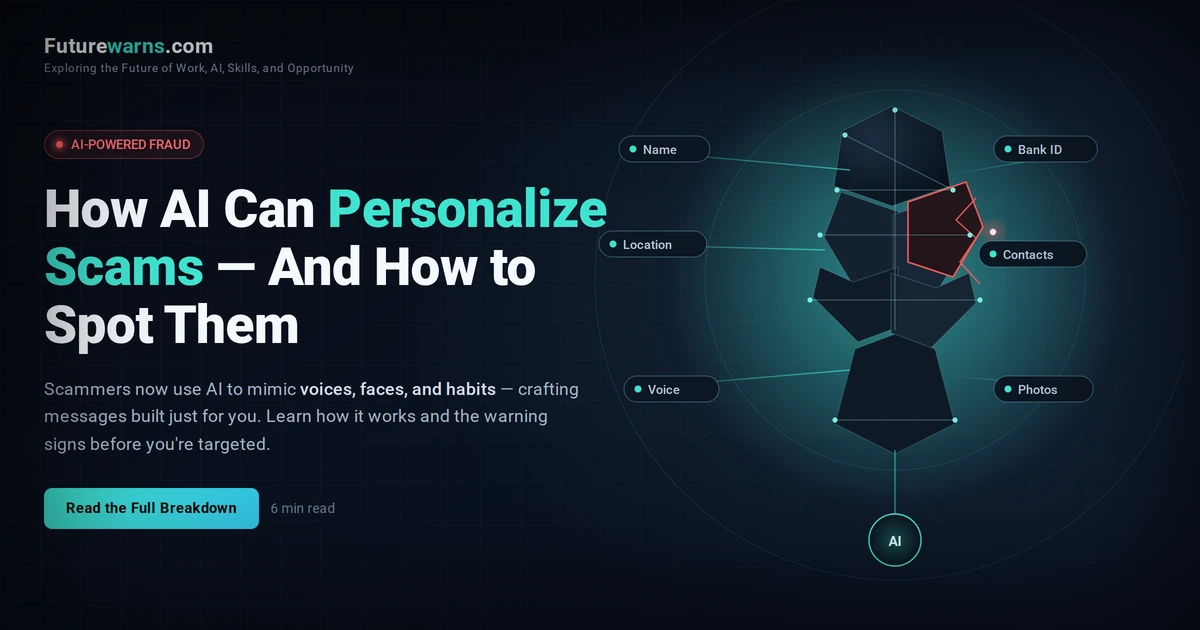
Your bank never called you. Your grandson never left that voicemail. Your “boss” never sent that urgent Slack message asking for gift cards. But they sounded exactly right — the tone, the background noise, even the little verbal habit only your real boss has. That is not a coincidence. That is AI, and it is now good enough to write, speak, and act like someone you trust.
This guide breaks down exactly how this happens, using real data from the FTC, FBI, and independent researchers — not guesswork. Then it gives you a practical, step-by-step system to spot these scams before they cost you money, your identity, or your peace of mind.
- 1. The Problem: Why Old Scam Advice No Longer Works
- 2. The Numbers: How Big Is This, Really?
- 3. How AI Actually Personalizes a Scam
- 4. Anatomy of an AI-Personalized Scam (Flowchart)
- 5. Six Types of AI-Powered Scams You’ll Actually Meet
- 6. Real Case Studies
- 7. How to Detect an AI-Personalized Scam
- 8. Step-by-Step Verification Checklist
- 9. Tools That Can Help You Fight Back
- 10. Common Mistakes People Make
- 11. Future Outlook: Where This Is Heading
- 12. FAQ
- 13. Key Takeaways
1. The Problem: Why Old Scam Advice No Longer Works
For years, the advice was simple: watch for bad grammar, weird email addresses, and generic greetings like “Dear Customer.” That advice is now outdated. Generative AI writes flawless emails, clones voices from a three-second audio clip, and can hold a real-time conversation that adjusts to what you say. The old red flags are disappearing, and new, subtler ones have taken their place.
What makes this shift dangerous is not just the quality of the fake — it is the personalization. A scammer used to send the same email to a million people and hope a few hundred fell for it. Now, AI tools let a single scammer build one thousand different, custom-tailored attacks in the time it used to take to write one.
2. The Numbers: How Big Is This, Really?
Fraud losses have been climbing for years, but the AI-driven share of that growth is now large enough to track separately.
| Metric | Figure | Source |
|---|---|---|
| Total US fraud losses reported to FTC, 2025 | ~$15.9 billion (up 27% from 2024) | FTC 2025 data |
| Imposter scam losses, 2025 | $3.5 billion | FTC |
| FBI-reported losses tied to AI-related scams, 2025 | $893 million | FBI IC3 |
| Projected US generative-AI fraud losses by 2027 | $40 billion (up from $12.3B in 2023) | Deloitte Center for Financial Services |
| Rise in AI-enabled scam activity detected in 2025 | 1,210% year-over-year surge | Industry security monitoring |
| Voice-cloning attacks against businesses, growth in 2025 | ~1,300% increase | Industry security monitoring |
The pattern is clear: fraud overall is rising fast, and the AI-enabled portion of it is rising even faster. Note on uncertainty: not every fraud report specifies whether AI was involved, so the true AI-attributed share is likely higher than officially recorded — most agencies agree these figures are an undercount, not an overcount.
3. How AI Actually Personalizes a Scam
Think of an AI-personalized scam as having three ingredients: data, generation, and delivery. Remove any one of these, and the scam falls apart.
3.1 Data: Building a profile of you
Scammers no longer need to hack anything. Most of what they need is already public: your LinkedIn job title, your Instagram vacation photos, your Facebook family tags, your company’s “About Us” page, even old interview clips on YouTube. AI tools can scrape and organize this in minutes, building a mini-dossier that includes your workplace, relationships, recent life events, and even your writing style from public comments.
3.2 Generation: Turning data into a convincing fake
Once the data is collected, generative AI creates the attack material:
- Text: Large language models write emails or messages in the exact tone of a real colleague, bank, or family member — no more clunky grammar.
- Voice: Voice-cloning tools need as little as three seconds of audio (pulled from a social media video or voicemail greeting) to recreate someone’s voice convincingly.
- Video: Deepfake video tools can superimpose a real person’s face and expressions onto a fake video call, sometimes in near real time.
- Behavior: Chatbots can hold ongoing, adaptive conversations, responding naturally to your doubts instead of relying on a rigid script.
3.3 Delivery: Choosing the right moment and channel
AI also helps scammers pick the best time and place to strike — right after you post about a trip, right when a company announces layoffs, or right during tax season. The message arrives exactly when your guard is down.
4. Anatomy of an AI-Personalized Scam (Flowchart)
Every step in this chain is a chance to break the attack. The most reliable break point is step four — pausing before you react emotionally.
5. Six Types of AI-Powered Scams You’ll Actually Meet
| Scam Type | How AI Is Used | Typical Target |
|---|---|---|
| Voice cloning (“family emergency”) | Clones a relative’s voice from a short clip to fake a distress call | Parents, grandparents |
| CEO / business email compromise | Mimics a manager’s writing style and requests urgent wire transfers | Employees in finance/HR |
| Romance scams | AI chatbots sustain months-long relationships, sometimes with deepfake video calls | Dating app users |
| Investment / crypto scams | Deepfake videos of celebrities or CEOs promoting fake platforms | Retail investors |
| Job scams | AI-written job offers and fake recruiter chats to harvest personal data or fees | Job seekers |
| Bank/government impersonation | AI voice bots or cloned agent voices claiming your account is compromised | General public, especially older adults |
6. Real Case Studies
Case Study 1: The Fake Robocall Voice in a US Primary
In early 2024, robocalls using an AI-cloned voice of a US political figure discouraged voters from participating in a state primary. The incident was significant enough that the Federal Communications Commission moved to classify AI-generated voices in robocalls as “artificial or prerecorded voices” under the Telephone Consumer Protection Act — making unsolicited AI-voice robocalls explicitly illegal. It showed regulators that voice cloning had moved from novelty to real-world manipulation risk.
Case Study 2: The “Grandparent Scam,” Upgraded
Traditional grandparent scams relied on a stranger’s voice and a shaky story. Security researchers have documented how, with just a few seconds of audio pulled from a social media video, voice-cloning tools can now recreate a specific grandchild’s voice, crying and asking for emergency bail or medical money. Consumer protection agencies including the FTC and AARP have issued direct warnings about this exact pattern.
Case Study 3: Business Impersonation at Scale
FTC data shows business impersonators — criminals pretending to represent a bank or company — caused about $1 billion in reported losses in 2025 alone, with the highest losses tied to fake bank representatives. While not every one of these cases involved AI, fraud analysts note that AI voice and text tools are increasingly the production line behind these impersonation scripts, making them faster to produce and harder to distinguish from real customer service contact.
7. How to Detect an AI-Personalized Scam
AI fakes are good, but they are rarely perfect. Here is what to watch for.
7.1 Listen and watch for small glitches
- Slightly flat or “off” emotional tone in a voice, especially during unscripted moments
- Unnatural pauses, or breathing patterns that don’t match normal speech
- In video calls: odd blinking, lighting that doesn’t match the background, or lips slightly out of sync with words
- Background noise that never changes — real phone calls have inconsistent ambient sound
7.2 Watch for behavioral red flags
- Urgency that skips normal steps (“don’t tell anyone,” “act right now,” “don’t call the office”)
- A request to move to an unusual payment method: gift cards, crypto, wire transfer
- The person avoids answering a very specific, personal question only the real individual would know
- Contact comes through a new or unfamiliar channel, even if the name looks right
7.3 Check the technical layer
| Check | What to Do |
|---|---|
| Sender email address | Hover or tap to see the full address, not just the display name |
| Links | Don’t click — type the company’s known URL directly into your browser |
| Phone number | Call back using the number saved in your contacts or on the official website, never the number that called you |
| Images/video | Reverse-image search a screenshot; check for AI artifacts around hands, ears, jewelry |
8. Step-by-Step Verification Checklist
- Pause. Urgency is the single biggest tell. Real emergencies rarely require secrecy or instant payment.
- Verify independently. Call the person or company back using a number you already had, not one from the message.
- Ask a knowledge question. Something only the real person would know — an inside joke, a recent shared memory.
- Check the channel. Did your bank ever text you before? If not, that’s already suspicious.
- Slow the money down. Never wire money, buy gift cards, or send crypto under pressure. Legitimate institutions never ask for these.
- Report it. File with your national fraud reporting body (e.g., the FTC at ReportFraud.ftc.gov in the US, or Action Fraud in the UK) even if you didn’t lose money — this data helps stop the next attack.
9. Tools That Can Help You Fight Back
| Tool / Resource | What It Does |
|---|---|
| FTC ReportFraud.ftc.gov | Official US fraud reporting portal; also has consumer alerts on AI voice cloning |
| FBI IC3.gov | Internet Crime Complaint Center; tracks AI-related fraud trends |
| AARP Fraud Watch Network Helpline | Free live support for identifying and reporting scams (US) |
| Reverse image / video search tools | Helps confirm whether a profile photo or video clip is stolen or synthetic |
| Bank and carrier fraud alerts | Enable real-time transaction alerts so unusual activity is flagged instantly |
| Family “safe word” | A private, agreed-upon phrase that only real family members know — extremely effective against voice-clone scams |
10. Common Mistakes People Make
- Trusting caller ID or a familiar name alone. Both can be spoofed or cloned.
- Reacting instead of verifying. Panic is the scammer’s biggest ally.
- Assuming only older adults are targeted. Job scams and romance scams increasingly target younger adults too.
- Believing “I’d know if it wasn’t really them.” Studies on voice-cloning show even attentive listeners struggle to tell a high-quality clone from a real voice over the phone.
- Not reporting near-misses. Even a scam you avoided is useful data for protecting others.
11. Future Outlook: Where This Is Heading
Fraud analysts, including Deloitte’s Center for Financial Services, project that generative-AI-enabled fraud losses in the US could rise from roughly $12.3 billion in 2023 to as much as $40 billion by 2027. That is not a certainty — it is a projection based on current growth trends — but it points in one direction: personalization will keep improving, and detection will need to keep pace.
On the positive side, the same AI technology is being built into fraud-detection systems at banks, telecom companies, and platforms, flagging cloned voices and synthetic video in real time. Regulation is also catching up — the FCC’s 2024 ruling against AI robocalls is an early example of laws adapting to this new threat. The realistic expectation is an ongoing arms race: as detection tools improve, so will the fakes. The best long-term defense will always be a mix of technology and simple, disciplined human habits — the pause-and-verify step will not go out of date.
Key Takeaways
- AI scams work by combining scraped personal data, generated fake content (text, voice, video), and precisely timed delivery.
- US fraud losses hit roughly $15.9 billion in 2025, and AI-related fraud is projected to keep growing sharply through 2027.
- Urgency and secrecy are the two biggest behavioral red flags, regardless of how convincing the voice or message sounds.
- Independent verification — calling back on a known number — defeats almost every AI-personalized scam.
- A family safe word is one of the simplest, most effective defenses against voice-cloning scams.
FAQ
Can AI really clone someone’s voice from just a few seconds of audio?
Yes. Independent research from cybersecurity firms has shown that modern voice-cloning tools can produce a convincing replica from as little as three seconds of clear audio, often pulled from a public social media video or voicemail greeting.
Is it illegal to use AI to impersonate someone in a scam?
In most countries, impersonation for fraud is already illegal under existing fraud and identity-theft laws, and regulators are adding AI-specific rules on top. In the US, the FCC’s 2024 ruling classified AI-generated voices in robocalls as covered under the Telephone Consumer Protection Act.
Are older adults the only targets of AI scams?
No. Older adults do report higher dollar losses on average, but job scams, romance scams, and crypto investment scams increasingly target younger adults, who are actually more likely to lose money proportionally, even if the total amounts are smaller.
What should I do immediately if I think I’ve been scammed?
Contact your bank or payment provider immediately to try to halt or reverse the transaction, change any shared passwords, and file a report with your national fraud authority (FTC in the US, Action Fraud in the UK, or your local cybercrime unit). Acting within the first hour significantly improves the chance of recovering funds.
Can AI detection tools reliably spot deepfakes?
Detection tools are improving but are not foolproof, and this is a fast-moving area where today’s detection method may be outdated within months. Combining technical detection with basic verification habits (calling back on a known number, asking personal questions) remains the most reliable defense.
Related Reading on FutureWarns
- Read more: How to Spot a Deepfake Video in 2026
- Read more: The Grandparent Scam Just Got an AI Upgrade
- Read more: The Complete Guide to Spotting Phishing Emails in the AI Era
- Read more: How Banks Are Using AI to Fight AI-Powered Fraud
- Read more: How to Shrink Your Digital Footprint So Scammers Have Less to Work With
Sources & Further Reading
Federal Trade Commission (FTC.gov) — 2025 fraud and imposter scam data · FBI Internet Crime Complaint Center (IC3.gov) — AI-related fraud loss reporting · Federal Communications Commission — 2024 ruling on AI-generated robocall voices · Deloitte Center for Financial Services — generative AI fraud loss projections · AARP Fraud Watch Network — older adult fraud trends. This article separates confirmed data (cited above) from reasonable projections, which are labeled as such throughout.
This article is for general awareness and does not replace professional legal, financial, or law-enforcement advice. If you are currently being targeted by a scam involving immediate financial risk, contact your bank and local authorities right away.
1 thought on “How AI Can Personalize Scams and How to Detect Them”