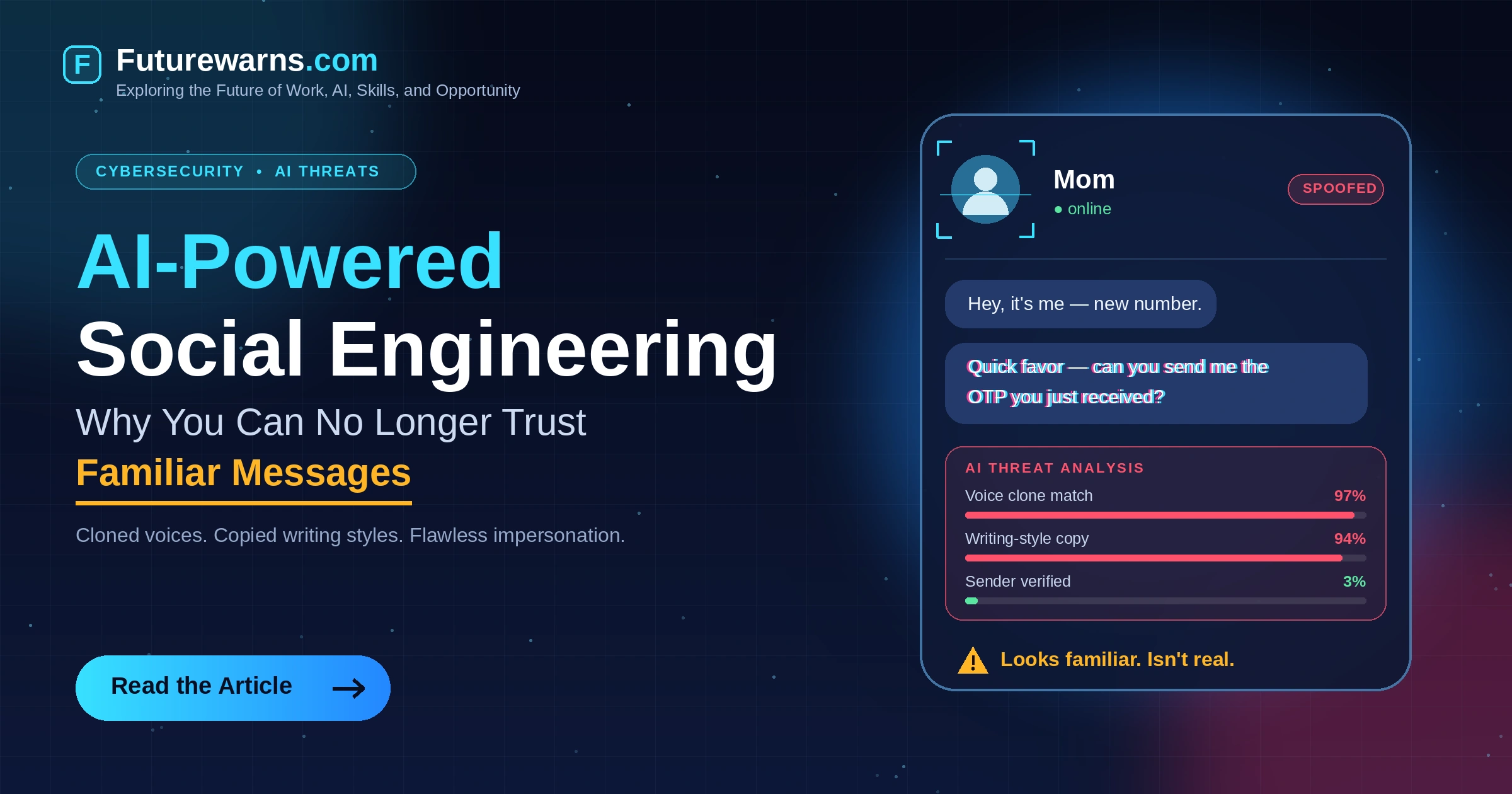
Your daughter calls, crying, asking for bail money. Your CEO messages you on Teams asking for an urgent wire transfer. Your bank’s fraud department phones to “verify” a suspicious charge. All three voices are real. All three are fake. Welcome to 2026, where the biggest threat to your money and your privacy isn’t a stranger — it’s a perfect copy of someone you trust. Let us discuss- AI-Powered Social Engineering: Why You Can No Longer Trust Familiar Messages.
Quick answer: AI-powered social engineering uses voice cloning, deepfake video, and AI-written messages to impersonate people you already trust — a family member, a boss, a bank, a colleague. Because the voice or writing style sounds genuine, traditional advice like “watch for bad grammar” or “you’ll recognise their voice” no longer works. The only reliable defence is independent verification: never confirm identity or urgency through the same channel the message arrived on. Call back on a number you already had saved, use a family “safe word,” and slow down before acting on anything urgent.
Table of Contents
- What Is AI-Powered Social Engineering?
- Why This Is Exploding Right Now
- The Numbers: How Big Is the Problem?
- How an AI Social Engineering Attack Actually Works
- The Main Attack Types You’ll Encounter
- Real Case Studies
- Why “I’d Recognise Their Voice” No Longer Works
- The Practical Defence Plan (Step-by-Step)
- Tools and Services That Can Help
- Common Mistakes People Make
- What Businesses Should Do Differently
- Future Outlook: What Happens Next
- Key Takeaways
- Frequently Asked Questions
What Is AI-Powered Social Engineering?
Social engineering is an old trick with a new engine. It simply means tricking a person into handing over money, access, or information — instead of hacking a computer, you hack trust. Fraudsters have used this for decades: the fake IRS agent on the phone, the “Nigerian prince” email, the con artist posing as a locksmith.
What changed is the tooling. Generative AI can now produce a convincing clone of someone’s voice from a few seconds of audio, generate a live video of a person’s face saying anything the attacker types, and write a phishing email that reads exactly like your colleague’s usual tone — spelling mistakes and all, if that’s their style. The attacker no longer needs to imitate a stranger’s authority (like “the bank”). They can imitate someone you actually know.
That is the real shift, and it is why this topic deserves a dedicated warning. The old checklist — “look for typos,” “you’d know your own mother’s voice,” “deepfakes still look fake” — is becoming unreliable month by month.
Why This Is Exploding Right Now
Three things came together at once:
- Cheap, accessible voice-cloning tools. Several commercial and open-source tools can clone a voice from as little as three seconds of clear audio — roughly the length of a voicemail greeting or a short video clip.
- An ocean of public audio and video. Social media, YouTube, podcasts, and even voicemail greetings give attackers raw material for free. Consumer Reports found that most mainstream voice-cloning products lacked meaningful technical safeguards against this kind of misuse.
- AI-written text that no longer “sounds AI.” Large language models can mimic a specific person’s writing style, correct grammar in a natural way, and personalise a message using details scraped from LinkedIn, company websites, or data broker sites.
Put these together and you get an attack that is cheap to run, easy to scale, and hard to spot — which is exactly why regulators and security researchers are treating it as one of the fastest-growing fraud categories of the decade.
The Numbers: How Big Is the Problem?
Numbers in this space move quickly and different organisations measure things differently, so treat any single statistic as directional rather than gospel. Still, the direction is unmistakable — sharply up. Here is what official and industry sources reported through mid-2026.
Sources: FBI Internet Crime Complaint Center (IC3) 2025 Annual Report; Federal Trade Commission consumer alerts; Consumer Reports voice-cloning safeguards study; industry incident tracking from cybersecurity vendors. Where figures come from private industry reports rather than government data, we’ve noted that separately below — some widely repeated numbers (like a “1,210% surge”) are cited across many blogs but do not appear in the official FBI IC3 report itself, so we treat them as industry estimates, not confirmed government statistics.
How an AI Social Engineering Attack Actually Works
Most attacks follow a predictable sequence, even though the technology behind them is advanced. Understanding the sequence is more useful than memorising any one scam story, because the pattern repeats across voice, video, and text.
Scrape voice/video/text samples from social media, work bios, voicemail
Generate a synthetic voice, face, or writing style
Send message via call, text, email, or video invite
“Don’t tell anyone,” “act in 10 minutes,” “I’m in trouble”
Wire transfer, gift cards, crypto, login credentials
Mind Map: What Attackers Need to Pull This Off
- Data
- Public social media posts and videos
- Company org charts and press releases
- Data broker profiles (phone numbers, relatives, addresses)
- Technology
- Voice cloning apps (some free, some subscription)
- Real-time video deepfake / “face swap” tools for live calls
- AI chat/text generators tuned to mimic a person’s tone
- Psychology
- Authority (“I’m your manager”)
- Urgency (“do this in the next 10 minutes”)
- Fear (“don’t tell anyone, or I’ll be arrested/hurt”)
- Familiarity (“it’s me, you know my voice”)
The Main Attack Types You’ll Encounter
| Attack type | How it works | Typical target |
|---|---|---|
| Voice cloning (“vishing”) | A cloned voice of a relative, boss, or bank official calls or leaves a voicemail asking for money or information urgently. | Families, elderly relatives, finance staff |
| Deepfake video calls | A live or pre-recorded video shows a familiar face (executive, colleague) instructing a transaction on a video conferencing platform. | Finance teams, executives’ assistants |
| AI-written spear phishing | An email or chat message mimics a real person’s tone, references real projects, and asks for credentials, invoices, or approvals. | Employees, HR, IT support |
| Fake job interviews / candidates | An attacker uses a deepfake identity to pass a video interview and gain insider access to a company. | Remote-hiring companies, especially tech and crypto firms |
| Romance and relationship scams | AI chatbots and cloned voices sustain long-term “relationships” that end in requests for money. | Individuals on dating apps and social platforms |
| Synthetic customer support | Fake “bank” or “tech support” bots imitate real support lines, sometimes using real hold music and scripts. | General consumers |
Real Case Studies
Case Study 1: The $25.6 Million Video Call
In 2024, a finance employee at UK engineering firm Arup joined what looked like a routine video call with the company’s CFO and several colleagues. Every face and voice on that call was an AI-generated deepfake. Believing the instructions were genuine, the employee authorised fifteen separate transfers totalling $25.6 million before the fraud was discovered. This remains one of the most cited examples of enterprise-grade deepfake fraud because it shows that even a group video call — not just a single phone call — can be entirely fabricated.
Case Study 2: The Modern “Grandparent Scam”
The classic grandparent scam — a stranger calls pretending to be a panicked grandchild who needs bail money — has existed for years. What’s new is that scammers now clone the actual grandchild’s voice, often pulled from a public TikTok or YouTube clip, and use it in the call. Reports collected by consumer protection agencies describe average losses in the range of several thousand dollars per incident, frequently paid through gift cards, wire transfers, or cash couriers posing as bail bondsmen.
Case Study 3: The Political Robocall
In early 2024, a robocall using an AI-cloned voice of a U.S. presidential candidate was sent to voters in New Hampshire, urging them not to vote. The Federal Communications Commission responded by ruling that AI-generated voices count as “artificial” under the Telephone Consumer Protection Act, making such robocalls illegal. This case shows the technology is being used well beyond financial fraud — including to manipulate public behaviour at scale.
“The technology to clone a voice has moved from Hollywood studios to a smartphone app in under a decade. The barrier to becoming a con artist has never been lower.” — Common observation echoed across FTC and FBI public consumer-fraud advisories, paraphrased for clarity
Why “I’d Recognise Their Voice” No Longer Works
Most people believe they’d instantly know if a voice were fake. That confidence is exactly what attackers rely on. Here’s the uncomfortable truth, in simple terms:
- Familiarity bias is strong. Once your brain hears a voice that sounds 90% like someone you know, combined with an emotionally urgent story, you fill in the remaining 10% yourself. Panic overrides scrutiny.
- Background noise hides flaws. Scammers often add “car noise” or “bad signal” to a call specifically to mask the small imperfections that a clean recording would reveal.
- You’ve never consciously analysed your loved one’s voice. You recognise it the way you recognise a face — instinctively, not analytically. That instinct is trainable to be fooled, especially under stress.
- Real-time cloning is improving fast. Early tools needed pre-recorded scripts. Newer ones can clone a voice and respond live in a conversation, which defeats simple tricks like “ask them something only they’d know” — because the attacker can pair the clone with information they’ve already gathered.
The Practical Defence Plan (Step-by-Step)
Here is a concrete plan you can put in place today, whether you’re protecting your family or your workplace.
For individuals and families
Step-by-step: what to do if you get “the call”
- Pause. Panic is the attacker’s weapon. Take a breath before reacting.
- Do not use the callback number they give you. Hang up and dial the number already saved in your phone for that person.
- Ask your pre-agreed family safe word. A cloned voice cannot know a word you never said publicly.
- Verify independently. Text another family member, or call the school, workplace, or embassy the story references.
- Never pay through gift cards, wire transfers, or crypto under time pressure. Legitimate authorities never demand these.
- Report it to your country’s fraud reporting body (see resources below), even if you didn’t lose money — this helps track patterns.
For employees and businesses
- Require a second-channel approval for any wire transfer above a set threshold — no exceptions, even for the CEO.
- Set up a verbal or digital “code phrase” for high-value approvals, changed periodically.
- Train finance and HR staff specifically on deepfake video-call scenarios, not just email phishing.
- Limit how much executive voice and video content is publicly available where possible.
- Build a “slow-down” culture — reward employees who pause and verify, instead of pressuring speed above all else.
- Run simulated deepfake phishing drills alongside standard phishing simulations.
Tools and Services That Can Help
| Category | What it does | Who it’s for |
|---|---|---|
| Caller ID authentication (STIR/SHAKEN) | Telecom-level protocol that verifies caller ID hasn’t been spoofed | Consumers (mostly automatic via carriers) |
| Deepfake detection software | Analyses audio/video for AI-generation artefacts | Enterprises, banks, media organisations |
| Identity verification platforms | Multi-factor, biometric-liveness checks for high-value approvals | Finance teams, HR/hiring |
| Security awareness training platforms | Simulate phishing, vishing, and deepfake scenarios to train staff | Businesses of all sizes |
| Password managers with phishing-resistant MFA | Reduces damage even if credentials are AI-phished | Everyone |
Common Mistakes People Make
| Common habit | Why people rely on it | Why it fails against AI |
|---|---|---|
| “I’ll recognise their voice” | Feels intuitive and personal | Modern cloning from a few seconds of audio can fool close family members, especially under stress |
| Looking for bad grammar in emails | Worked well against older phishing attempts | AI writing tools now produce fluent, personalised, error-free text |
| Trusting caller ID | Caller ID used to be hard to fake | Number spoofing is cheap and widely available |
| Assuming video calls are “proof of life” | Seeing someone’s face felt like undeniable evidence | Real-time deepfake video can mimic a live face on a call |
| Reacting immediately to urgency | Feels responsible and caring | Urgency is the attacker’s main psychological lever — it’s designed to stop you thinking |
What Businesses Should Do Differently
Most corporate security training still focuses heavily on email phishing — spotting suspicious links, checking sender domains. That’s still useful, but it’s no longer sufficient. Businesses need to treat voice and video channels with the same suspicion they’ve learned to apply to email.
A simple framework: Verify, Don’t Trust
- Verify the channel. If a request arrives by phone, verify by a different channel (email to a known address, or an in-person check).
- Verify the amount. Any financial request above a set threshold requires a second approver, regardless of who is “asking.”
- Verify the urgency. Genuine emergencies rarely require secrecy from colleagues or bypassing normal procedure — “don’t tell anyone” is a red flag, not a legitimate instruction.
Future Outlook: What Happens Next
This problem is not going away — but the response is maturing too. A few trends worth watching over the next few years:
- Regulation is catching up. The FCC’s ruling on AI-generated robocall voices and growing congressional scrutiny of voice-cloning companies (including direct inquiries sent to major providers in 2026) suggest tighter rules are coming for how these tools can be built and sold.
- Detection technology is improving, but so is evasion. Expect an ongoing arms race between deepfake detection tools and increasingly realistic generation tools — meaning technology alone will never be a complete solution.
- Identity verification will become a normal part of daily life. Just as two-factor authentication became standard for logins, expect “liveness checks” and code phrases to become standard for financial and family communication.
- Public awareness is the biggest lever. Every study on this topic points to the same conclusion: technical defences help, but the single most effective protection is a well-informed, slightly sceptical public that pauses before reacting to urgent, emotional messages.
Key Takeaways
- AI can now clone a voice from just a few seconds of audio and generate live deepfake video on calls.
- Old advice like “I’d know their voice” or “look for typos” is no longer reliable protection.
- The single best defence is independent verification through a second, known channel — every time.
- Families should agree on a safe word; businesses should require dual approval for financial requests, regardless of who appears to be asking.
- Reported losses are already in the hundreds of millions of dollars annually and almost certainly under-reported.
- Regulation and detection technology are improving, but human habits remain the strongest defence available today.
Frequently Asked Questions
Can AI really clone someone’s voice from a short clip?
Yes. Multiple documented cases and industry reports confirm that modern voice-cloning tools can produce a convincing replica from as little as three seconds of clear audio — shorter than a typical voicemail greeting.
How can I tell if a video call is a deepfake in real time?
It’s genuinely difficult, and getting harder. Watch for unnatural blinking, lighting mismatches, lag between lip movement and audio, or a refusal to turn their head or perform an unscripted action (like touching their face). But don’t rely on this alone — always verify important requests through a separate channel.
Is it enough to just hang up and call the number back?
Only if you call a number you already had saved — never the number the caller gives you, texts you, or that appears on caller ID during that same call, since caller ID can be spoofed.
Are elderly people the main targets?
They are disproportionately targeted and disproportionately harmed financially, according to consumer protection data, but businesses, young professionals, and even journalists and public figures have also been targeted through executive impersonation and political deepfakes.
What should I do if I’ve already sent money to a scammer?
Contact your bank or payment provider immediately to attempt a reversal or freeze, then file a report with your national fraud reporting body (FBI IC3 or FTC in the US, Action Fraud in the UK, National Cyber Crime Reporting Portal in India). Acting within hours significantly improves the chance of recovering funds.
Can businesses insure against deepfake fraud?
Some cyber-insurance policies are beginning to address AI-enabled fraud and social engineering losses, but coverage varies widely and many policies exclude social engineering unless specific riders are purchased. Review your policy with a qualified insurance advisor.
Conclusion
The uncomfortable truth is simple: the voice on the phone, the face on the video call, and the message in your inbox can no longer be trusted just because they sound or look familiar. That doesn’t mean living in constant suspicion of everyone you know — it means building one small, powerful habit: verify urgent or financial requests through a second, independent channel, every time, without exception. That single habit, more than any piece of software, is what stands between you and becoming the next statistic in this fast-growing category of fraud.
Don’t stop here — the next scam won’t announce itself.
Explore more FutureWarns cybersecurity guides to stay a step ahead of the next AI-driven threat.