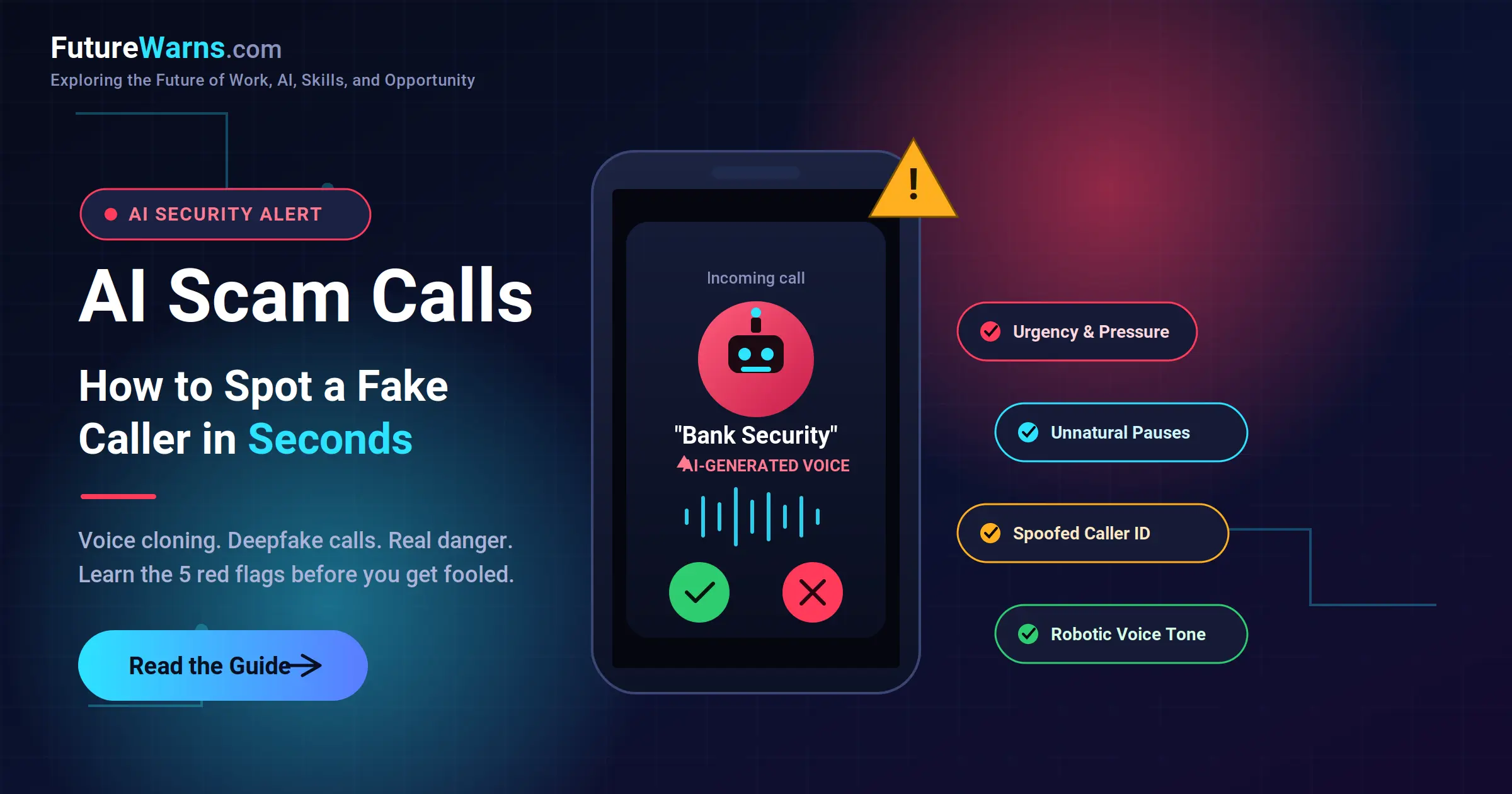
Your phone rings. It’s your daughter’s voice — shaking, scared, saying she’s been in an accident and needs money right now. Except she’s not in an accident. She’s asleep upstairs. What you just heard was built from nine seconds of a video she posted last month, and the person on the other end paid less than a dollar to make it.
This isn’t a hypothetical. AI-driven voice scams surged an estimated 1,210% in 2025 alone, according to research cited by Fox News and multiple fraud-monitoring firms, and the FBI’s Internet Crime Complaint Center logged 22,364 AI-related fraud complaints in 2025 with $893 million in reported losses — and that’s almost certainly an undercount, since researchers estimate fewer than 5% of voice-clone victims ever file a report. This guide gives you the exact, field-tested way to spot a fake caller, verify a real one, and protect the people in your life who are most likely to be targeted.
Table of Contents
- The Problem: Why Your Ears Can No Longer Be Trusted
- How AI Voice Cloning Actually Works
- The Numbers: How Big Is This Really?
- 7 Red Flags That Reveal an AI Scam Call
- The 10-Second Verification Test
- Decision Flowchart: Is This Call Real?
- Step-by-Step: What to Do During and After the Call
- Real Case Studies
- Tools and Apps That Help (and Their Limits)
- Common Mistakes People Make
- Who Scammers Target Most
- Future Outlook: What’s Coming Next
- FAQ
- Key Takeaways
1. The Problem: Why Your Ears Can No Longer Be Trusted
For most of human history, hearing a loved one’s voice was proof enough. That assumption quietly broke sometime around 2023, and by 2026 it’s gone completely. Fortune reported in late 2025 that voice cloning has crossed what researchers call the “indistinguishable threshold” — the point where ordinary listeners can no longer reliably tell a cloned voice from a real one, even when they’re listening for it.
That matters because phone scams have always relied on one thing: trust built faster than suspicion. AI just removed the last barrier that made trust hard to fake. A scammer used to need acting skill, local knowledge, and time. Now they need nine seconds of audio scraped from a TikTok video, a voicemail greeting, or a wedding speech uploaded to YouTube.
2. How AI Voice Cloning Actually Works (In Plain English)
You don’t need a computer science degree to understand this, and honestly, understanding it is half the defense. Here’s the simplified version:
- Sample collection: The scammer grabs a short audio clip of the target’s voice — from Instagram Reels, a podcast appearance, a company earnings call, a YouTube comment reply, or even a “wrong number” call where you say a few sentences before hanging up.
- Voice modeling: That clip is fed into a voice-cloning tool. Modern systems need as little as 3 seconds of clear audio to build a usable voice model, per McAfee’s research.
- Script generation: A large language model (LLM) writes a persuasive, personalized script — sometimes referencing real details scraped from social media, like a recent trip or a family member’s name.
- Real-time delivery: The cloned voice reads the script live over a spoofed phone number, adjusting tone and pacing to sound distressed, urgent, or authoritative.
Total cost to a scammer for a convincing, real-time cloned-voice call in 2026: often under $50 in cloud compute, run on a consumer-grade GPU. That’s the uncomfortable part — this is no longer expensive, rare, or reserved for nation-state actors. It’s a commodity.
The Three Scam Formats You’ll Actually Encounter
| Format | Who Gets Called | Typical Script |
|---|---|---|
| Grandparent / Family Emergency Scam | Older adults, parents | “Grandma, I’ve been in an accident, please don’t tell Mom, I need bail money” |
| Executive / CFO Fraud (Vishing) | Finance and accounts payable staff | “I’m in a closing, wire $480,000 now, don’t loop in legal yet” |
| Bank or Government Impersonation | General public, especially seniors | “Your account has been compromised, verify your PIN to secure it” |
3. The Numbers: How Big Is This Really?
Numbers help cut through the panic and show exactly where the risk is concentrated. Here’s what the most credible sources report as of 2026.
Sources: FBI Internet Crime Complaint Center (IC3) 2025 Annual Report; Deloitte Center for Financial Services; McAfee voice-cloning research; FTC consumer alerts. Figures reflect reported cases only — actual losses are believed to be substantially higher since most incidents go unreported.
Illustrative growth trend based on FBI IC3 confirmed 2025 figure of $893M and industry growth-rate estimates. *2022–2024 and 2026 figures are directional estimates based on reported year-over-year growth rates (1,210% surge in 2025), not official IC3 line items — treat as illustrative, not exact.
4. 7 Red Flags That Reveal an AI Scam Call
Cloned voices are getting better, but the technology still leaves fingerprints — mostly in timing, emotion, and context, not in the sound of the voice itself. Here’s what to listen for.
1. Emotional flatness under “extreme” stress
A person who is genuinely panicking has irregular breathing, cracks in their voice, and messy pacing. AI-generated distress often sounds smoother than real distress — like an actor reading fear off a page rather than feeling it.
2. Unnaturally clean audio with zero background texture
Real emergencies are messy. Traffic, hospital PA systems, other voices, wind. If the “accident scene” or “police station” sounds like a quiet recording booth, be suspicious.
3. Refusal to answer an unscripted question
This is the single most reliable tell. AI clones repeat trained phrases well but stumble on spontaneous, unexpected questions — especially ones requiring personal memory only the real person would have.
4. Pressure to stay on the line and act immediately
“Don’t hang up,” “don’t tell anyone,” “do this in the next 10 minutes” — these instructions exist to prevent you from doing exactly what defeats the scam: verifying independently.
5. Unusual payment requests
Gift cards, wire transfers, cryptocurrency, or a “bail bondsman” courier picking up cash are the overwhelming majority of scam payment methods. Legitimate emergencies almost never require these.
6. Slight timing lag or robotic cadence in real-time deepfake calls
Live voice-cloning still introduces small processing delays. If responses come a half-second late, or words land with oddly even spacing, that’s a signal — though this gap is closing fast as tools improve.
7. The number looks familiar but something feels off
Caller ID spoofing costs scammers a fraction of a cent per call and works against nearly every carrier. A familiar area code or even the exact saved number appearing on your screen proves nothing.
5. The 10-Second Verification Test
You don’t need special software to catch most fake callers. You need a script you can run in your head, every single time, without exception — even when the voice sounds exactly right.
| Step | What You Do | Why It Works |
|---|---|---|
| 1 | Pause before reacting. Don’t say the family member’s name out loud — it can be recorded and reused. | Denies the scammer new audio to refine the clone further. |
| 2 | Ask one unscripted question only the real person would know (a private nickname, last week’s dinner, a shared memory). | AI models trained on public data can’t answer private, spontaneous questions. |
| 3 | Say you’ll call them back, then hang up — regardless of protests. | Breaks the scammer’s control of the conversation and their pressure tactic. |
| 4 | Call the person back on a number already saved in your phone — never a number given during the call. | This is the FTC’s official top recommendation and defeats caller-ID spoofing entirely. |
| 5 | If unreachable, contact another family member or the person’s workplace to confirm their location. | Independent, out-of-band confirmation is the only verification method AI cannot fake. |
“An AI voice scam relies on a cloned voice plus urgency, so a callback on a saved number breaks it.” — FTC consumer guidance, as summarized in 2026 fraud-prevention reporting
6. Decision Flowchart: Is This Call Real?
A simple decision path you can run through mentally during any suspicious call.
7. Step-by-Step: What to Do During and After the Call
During the call
- Stay calm — panic is the scammer’s main tool, not the technology.
- Do not confirm personal details, account numbers, or say “yes” repeatedly (some scams record “yes” for voice-authorization fraud).
- Ask a private, unscripted question.
- State clearly that you will call back, then end the call.
Immediately after
- Call the person back on a saved, trusted number.
- If money was requested, contact your bank’s fraud line directly — not through any number given during the call.
- If you sent money via wire transfer, gift card, or crypto, report it immediately; wire transfers can sometimes be recalled within hours if reported fast.
- Report the incident to the FTC at reportfraud.ftc.gov and to the FBI’s IC3 at ic3.gov.
- Warn family members in the same call chain — scammers often target multiple relatives from one leaked contact list.
8. Real Case Studies
Case Study 1: The $25.6 Million Deepfake Video Call (Arup, 2024)
A finance employee at engineering firm Arup’s Hong Kong office joined what appeared to be a routine video call with the company’s CFO and several colleagues. Every face and every voice on that call was an AI-generated deepfake. Believing the instructions were genuine, the employee authorized 15 separate wire transfers totaling $25.6 million before the fraud was discovered. This remains one of the most cited examples of how convincing real-time deepfake video and audio have become — even for trained finance professionals used to spotting fraud.
Case Study 2: The Cloned Teenager (2023–2024, Widely Reported)
A mother received a call and heard what sounded exactly like her 15-year-old daughter sobbing, with a man’s voice in the background demanding ransom money. Her daughter was, in reality, safely on a ski trip at the time. Investigators later confirmed the voice clone had been built from just a few seconds of audio pulled from the daughter’s own social media posts — a reminder that public videos, voice notes, and even voicemail greetings are all usable source material.
Case Study 3: Executive Impersonation for Wire Fraud
A cloned “CEO” voice called an accounts payable clerk directly, instructing an urgent wire of $480,000 for a “closing” and specifically asking that legal and management not be looped in until after the transfer. The follow-up instructions arrived by email from a spoofed lookalike domain. This pattern — urgency plus a request for secrecy plus an unusual payment channel — is now one of the most common corporate vishing scripts reported by incident-response firms.
9. Tools and Apps That Help (and Their Real Limits)
No app can fully replace judgment, but a few tools genuinely reduce your exposure. Here’s an honest look, including where each one falls short.
| Tool / Service | What It Actually Does | Limitation |
|---|---|---|
| Carrier-level call filtering (built into most phone plans) | Flags known spoofed or scam numbers before you answer | Cannot detect a cloned voice once you’ve already answered |
| Hiya / carrier-integrated scam ID apps | Real-time caller reputation scoring | Works through carrier partnerships, not as a standalone purchase for everyone |
| Bank-side voice biometric verification | Some banks now flag calls that don’t match a customer’s stored voiceprint | Only protects banking calls, not personal or family calls |
| Family “safe word” system | A private code phrase only real family members know | Requires everyone to actually set it up and remember it — free but needs discipline |
| Deepfake/AI content detectors (media-focused) | Can flag AI-generated video or audio files after the fact | Mostly useful for recorded content, not live phone calls in real time |
10. Common Mistakes People Make
- Trusting caller ID because the number “looks right” — spoofing is nearly free and works against most carriers.
- Redialing the number that just called instead of using a saved contact.
- Sharing personal details “just to be safe” during the call itself, which can hand the scammer more material.
- Staying on the line out of guilt or fear when someone claims to be in danger — hanging up to verify is always the safer move.
- Assuming older relatives are the only targets — corporate finance staff are now heavily targeted through executive impersonation.
- Believing that “I would know my own child’s voice” — research shows even attentive listeners are fooled by current-generation clones.
11. Who Scammers Target Most
While anyone can receive an AI scam call, the data shows clear patterns worth knowing.
| Group | Why They’re Targeted | Reported Impact |
|---|---|---|
| Adults 60+ | Often have savings, are more trusting of urgent family requests, less familiar with AI capabilities | $7.75 billion lost in 2025, up 59% year over year; $352 million specifically tied to AI-related fraud among seniors |
| Finance and accounts payable staff | Direct authority to move company funds quickly | Organizations report average annual losses of roughly $14 million to vishing-style attacks |
| Parents of teens and young adults | Emotional trigger of a “child in danger” overrides normal skepticism | Average reported loss per incident around $11,000, often paid via gift cards or crypto |
12. Future Outlook: What’s Coming Next
It would be dishonest to pretend detection tools will stay ahead of generation tools forever — right now, they aren’t. Real-time deepfake video has moved from obvious, flickering fakes to consistent, interactive avatars that fool experienced professionals in live calls, as the Arup case demonstrated. Industry researchers project AI-driven fraud losses could reach $40 billion globally by 2027.
At the same time, defenses are catching up in specific areas:
- The FCC ruled in February 2024 that AI-generated voices count as “artificial” under the Telephone Consumer Protection Act, giving regulators a clearer legal path to prosecute AI robocalls.
- Banks are increasingly piloting voice biometric systems that flag mismatched voiceprints during high-risk transactions.
- Carriers continue expanding free call-authentication standards (like STIR/SHAKEN in the U.S.) to reduce number spoofing, though adoption is uneven globally.
The honest takeaway: technology alone won’t solve this in the next few years. Human verification habits — the callback rule, the safe word, the unscripted question — will remain your most reliable defense for the foreseeable future, simply because they don’t depend on AI ever losing the arms race.
Frequently Asked Questions
Can AI really clone someone’s voice from a few seconds of audio?
Yes. Current voice-cloning systems can produce a convincing clone from as little as three seconds of clear speech, according to McAfee’s research. A voicemail greeting, a short social media clip, or even a few words spoken during a “wrong number” call can be enough source material.
Is it illegal to use AI to fake someone’s voice in a scam call?
Yes, in the United States. The FCC ruled on February 8, 2024, that AI-generated voices are classified as “artificial” under the Telephone Consumer Protection Act, making unauthorized AI robocalls illegal. Laws vary by country, so always check your local telecom regulator for specifics.
What should I do if I already sent money to a scammer?
Contact your bank’s fraud department immediately using a number from your card or official statement, not any number given during the scam call. Report the incident to the FTC at reportfraud.ftc.gov and the FBI’s IC3 at ic3.gov as soon as possible — faster reporting improves the chance of recovering wire transfers.
Does caller ID prove who is calling me?
No. Caller ID spoofing is inexpensive — reportedly as low as $0.003 per call — and works against most carriers. A call showing a trusted name or number is not proof of identity by itself.
Are older adults the only ones at risk?
No. While adults 60+ report the highest total dollar losses, corporate finance teams, parents of teenagers, and even tech-savvy professionals have been successfully targeted, particularly through executive impersonation and real-time deepfake video calls.
What is a “family safe word” and does it actually work?
It’s a private code phrase agreed upon in advance among family members, used to confirm identity during unexpected or distressing calls. Security experts recommend it because it defeats even a perfect voice clone — an AI model cannot generate a specific private word or phrase it was never trained on.
Key Takeaways
- AI can convincingly clone a voice from as little as 3 seconds of audio — public social media clips are enough.
- The single most effective defense is calling back on a number you already have saved, never one given during the call.
- Ask an unscripted, private question — AI clones struggle with spontaneous, personal recall.
- Never trust caller ID alone; spoofing is cheap and widespread.
- Set up a family safe word today — it’s free and defeats even perfect voice clones.
- Report incidents quickly to the FTC and FBI IC3 — speed matters for recovering wire transfers.
- Finance teams should treat any urgent, secretive wire request as a red flag requiring independent verification, regardless of who the voice sounds like.
Stay one step ahead of the next AI scam
AI-driven fraud is evolving every month. FutureWarns tracks the real threats — and the real defenses — so you don’t have to.
Explore More AI Safety GuidesSources referenced: FBI Internet Crime Complaint Center (IC3) 2025 Annual Report · Federal Trade Commission (FTC) consumer fraud alerts · Federal Communications Commission (FCC) TCPA ruling, February 8, 2024 · Deloitte Center for Financial Services · McAfee voice-cloning research · Reporting via Fortune, Fox News, and Forbes technology desks, cross-checked against official agency data.