In January 2024, an employee at a global engineering firm joined a video call with his CFO and several colleagues. Everyone on the screen looked and sounded real. None of them were. He approved transfers worth about US$25 million before anyone found out. That firm was Arup, and the story was widely reported.
Now ask yourself one thing: who do companies call after something like that? And who do they hire so it never happens again? Those people are about to become some of the most valuable workers in technology.
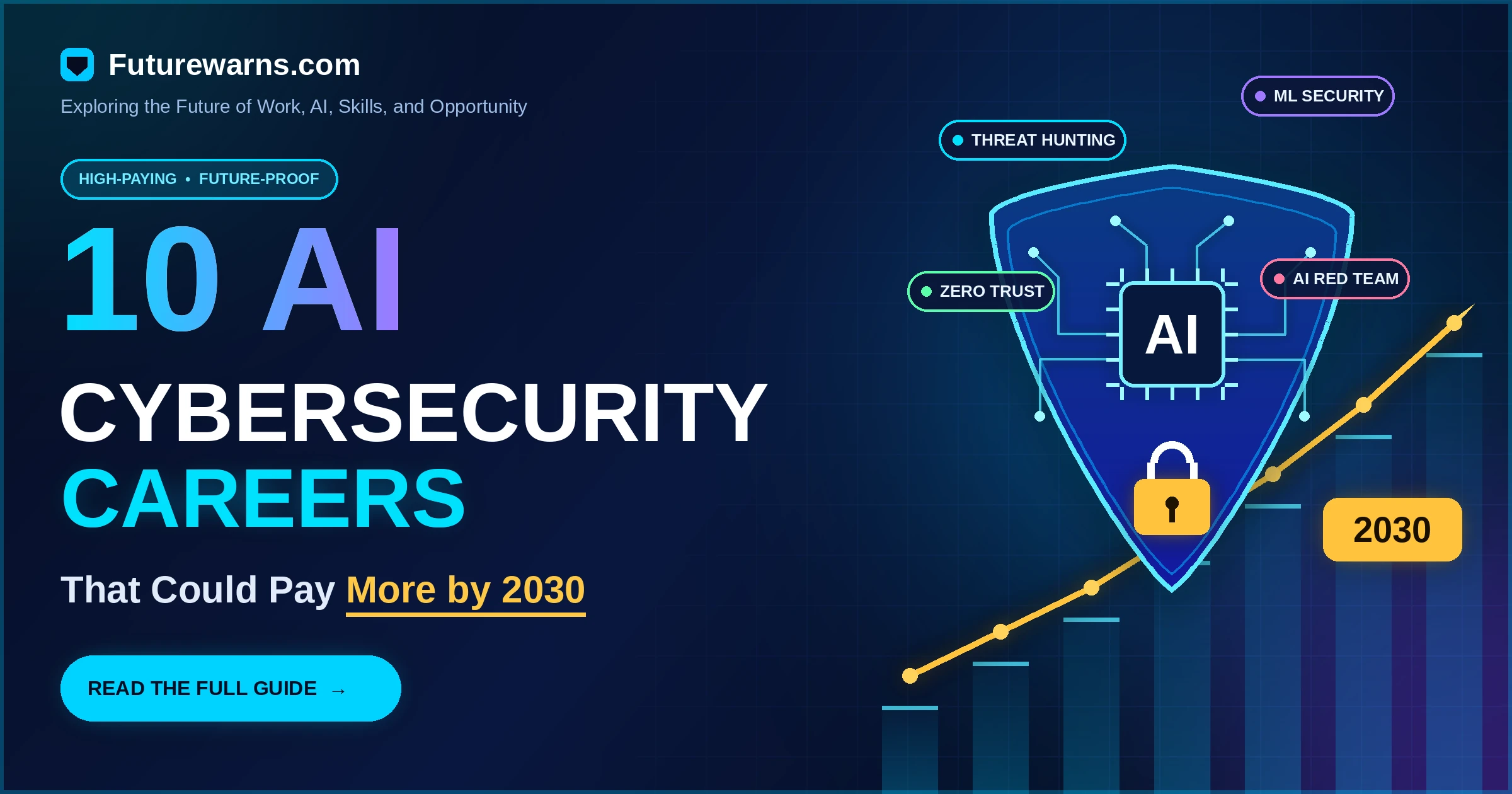
The AI cybersecurity careers with the strongest pay potential through 2030 are: AI Red Teamer, AI Security Architect, ML Security Engineer, AI Governance and Risk Lead, Deepfake Threat Analyst, AI-Enabled SOC Engineer, Agentic AI Security Specialist, AI Threat Intelligence Analyst, AI Privacy Engineer, and AI Incident Response Lead. Pay tends to rise where skills are rare and mistakes are expensive. Nobody can guarantee exact 2030 salaries, so treat every number about the future as an informed estimate, not a promise.
Introduction: Why This Topic Matters Now
Security jobs were already in demand. AI has made the shortage sharper. Companies are adding chatbots, copilots and automated agents to almost everything. Each one is a new door that attackers can try. Attackers also use AI to write better phishing emails, clone voices and find weaknesses faster.
That creates a simple economic pattern. When a skill is rare and the damage from errors is huge, employers pay more. This article shows you which roles fit that pattern, what each one actually does, and how to move toward one. I have separated facts (with sources) from opinions (clearly labelled) so you can judge for yourself.
The Problem: A Skills Gap Meets an AI Boom
Security teams were short-staffed long before generative AI arrived. The ISC2 Cybersecurity Workforce Study estimated the global gap at about 3.4 million in 2022, 4.0 million in 2023 and 4.8 million in 2024. After that, ISC2 shifted its focus toward skills shortages instead of headcount, so the newest picture is about which skills are missing, not only how many people.
The Risk: AI Adds New Attack Surfaces
The World Economic Forum’s Global Cybersecurity Outlook 2025 reported that about two-thirds of organisations expect AI to have the biggest effect on cybersecurity in the year ahead. Yet only about a third said they had a process to check the security of AI tools before using them. That mismatch is where new jobs are born.
IBM’s 2025 Cost of a Data Breach report adds another warning. Among organisations that reported a breach involving AI models or applications, the large majority lacked proper AI access controls. Put simply: companies are adopting AI faster than they are securing it.
What the Data Says
| Data point | Figure | Source |
|---|---|---|
| Global workforce gap (2024) | About 4.8 million | ISC2 |
| Average global breach cost (2025) | US$4.44 million | IBM |
| Average US breach cost (2025) | Over US$10 million | IBM |
| Median pay, information security analysts (US, 2024) | About US$124,900 per year | US Bureau of Labor Statistics |
| Projected job growth, information security analysts (US, 2024 to 2034) | About 29%, much faster than average | US Bureau of Labor Statistics |
Always check the latest release on each source’s website. These figures are updated every year.
That quote matters here. AI will not solve security by itself. It creates work for humans who understand both the technology and the problems.
How We Picked These 10 Careers
No official list ranks future AI security salaries, and anyone who claims one is guessing. So I used four tests that match how pay really works:
- Scarcity: few people have the skills today.
- Risk: a mistake can cost millions or break the law.
- Demand signal: frameworks, regulations or incidents point to growing need (for example the EU AI Act, NIST AI RMF and the OWASP Top 10 for LLM Applications).
- Reachability: a motivated person can realistically train for it.
Opinion note: The pay-potential ratings below are my editorial judgment based on these tests. They are not official salary forecasts.
The 10 AI Cybersecurity Careers
1. AI Red Teamer
What you do: You attack AI systems on purpose before real criminals do. You try prompt injection (tricking a chatbot with hidden instructions), data leaks and jailbreaks, then report how to fix them.
Why pay could rise: Big AI labs and regulators now expect adversarial testing. Good testers are hard to find because the work mixes hacking skill with creative thinking.
Skills: Penetration testing, Python, LLM behaviour, the OWASP LLM Top 10, MITRE ATLAS.
Good first step: Practise on public capture-the-flag challenges built for prompt injection and write up your findings.
2. AI Security Architect
What you do: You design how AI is used safely across a company. Where does data go? Who can call the model? What happens if it is poisoned?
Why pay could rise: Architects sit close to executives and carry big responsibility. Architecture roles usually pay well above entry-level security jobs.
Skills: Cloud security, zero trust, threat modelling, data governance, NIST AI RMF.
Good first step: Threat-model one real AI feature, such as a customer support bot, and publish the diagram.
3. ML Security Engineer (MLSecOps)
What you do: You secure the pipeline that builds models: training data, code, model files and deployment. Think of it as DevSecOps for machine learning.
Why pay could rise: It needs two skill sets that rarely meet, security engineering and ML engineering.
Skills: CI/CD security, supply chain security, container security, model scanning, Python.
Good first step: Learn how malicious model files and poisoned datasets work, then add scanning to a sample pipeline.
4. AI Governance, Risk and Compliance Lead
What you do: You turn laws and standards into daily rules. You check that AI systems meet requirements and that the company can prove it.
Why pay could rise: The EU AI Act entered into force in August 2024 with obligations phased in over several years. ISO/IEC 42001 gives a management standard for AI. Companies need people who can interpret both. Fines and lawsuits make this a boardroom topic.
Skills: Risk assessment, audit, privacy law basics, ISO 27001 and 42001, clear writing.
Good first step: Map one AI tool against the NIST AI Risk Management Framework.
5. Deepfake and Synthetic Media Threat Analyst
What you do: You help banks, media and governments spot fake voices, videos and documents, and you design checks so staff do not get fooled.
Real example: The Arup case above is the classic warning. The fix was not only technology. It was process: a second, independent way to confirm big payments.
Why pay could rise: Fraud losses are easy for finance teams to measure, so budgets follow quickly.
Skills: Fraud analysis, media forensics, open-source investigation, awareness training.
6. AI-Enabled SOC and Detection Engineer
What you do: You build and tune the systems that spot attacks, using machine learning and automation to cut noise. You also decide when to trust the AI and when to question it.
Why pay could rise: AI will handle more first-level alert triage. People who can build, supervise and fix that automation become more valuable than people who only click through alerts. This is my opinion, though early industry reports support the shift.
Skills: SIEM, detection engineering, scripting, MITRE ATT&CK, data analysis.
7. Agentic AI Security Specialist
What you do: AI agents can read email, run code and move money. You decide what each agent may touch and how to stop one from being hijacked.
Why pay could rise: This field is new, so experts are few. It is also uncertain: standards are still forming, and some job titles will change. Treat it as high potential with higher risk.
Skills: Identity and access management, API security, least privilege, logging and monitoring.
8. AI Threat Intelligence Analyst
What you do: You track how criminals and state groups use AI, from phishing kits to malware helpers, and tell your company what to expect.
Why pay could rise: Good analysts turn noise into decisions. Leaders pay for clear warnings. AI companies have published threat reports on misuse of their models, which shows the topic is real.
Skills: Research, report writing, OSINT, malware basics, geopolitical awareness.
9. AI Privacy and Data Protection Engineer
What you do: You make sure models do not memorise or leak personal data. You work on anonymisation, access limits and data deletion.
Real example: In 2023, media reported that Samsung engineers pasted internal code into a public chatbot, and the company restricted its use. It shows how easily private data leaves through normal work habits.
Skills: Privacy engineering, GDPR and similar laws, data classification, differential privacy basics.
10. AI Incident Response Lead
What you do: When an AI system misbehaves or is attacked, you lead the response. You contain the damage, talk to legal and communications teams, and fix the root cause.
Why pay could rise: IBM’s research shows breaches that take longer to find and contain cost more. Leaders who can act calmly and fast save real money.
Skills: Incident response, forensics, communication under pressure, AI system knowledge.
Comparison Table
| Career | Pay potential (editorial view) | Entry difficulty | Coding needed | Best for |
|---|---|---|---|---|
| AI Red Teamer | Very high | High | Medium | Ex-pentesters |
| AI Security Architect | Very high | High | Low to medium | Senior engineers |
| ML Security Engineer | Very high | High | High | DevOps or ML engineers |
| AI GRC Lead | High | Medium | Low | Auditors, compliance staff |
| Deepfake Threat Analyst | High | Medium | Low | Fraud and media analysts |
| AI SOC Engineer | High | Medium | Medium | SOC analysts |
| Agentic AI Security | High but uncertain | High | Medium | IAM and API specialists |
| AI Threat Intel Analyst | Medium to high | Medium | Low | Researchers |
| AI Privacy Engineer | High | Medium to high | Medium | Privacy and data staff |
| AI Incident Response Lead | High | High | Medium | Experienced responders |
Ratings are relative and based on scarcity, risk and demand. They are not salary guarantees. Pay differs a lot by country, company size and experience.
Mind Map and Career Flow
Step-by-Step Plan to Get Started
Step 1: Build the base (months 1 to 3)
Learn networking, operating systems and basic security. If you are new, a recognised entry certification such as CompTIA Security+ or ISC2 Certified in Cybersecurity can give structure. Learn Python too. It is the glue of both security and AI work.
Step 2: Learn how AI breaks (months 3 to 5)
Read the OWASP Top 10 for LLM Applications. Browse MITRE ATLAS, which catalogues real attack techniques against AI systems. Understand five ideas: prompt injection, data poisoning, model theft, data leakage and over-powered agents.
Step 3: Pick one track (month 5)
Use the mind map. Technical and curious? Try red teaming or ML security. Good with documents and people? Try governance or privacy. Calm under pressure? Look at incident response.
Step 4: Build public proof (months 5 to 9)
Employers trust evidence. Create two or three small projects:
- A threat model for a chatbot, with a diagram and a risk list.
- A write-up of a prompt injection test on a safe, legal practice platform.
- A one-page AI usage policy for a small company.
Step 5: Add a credential that fits (months 9 to 12)
Choose based on your track: cloud security certificates for architects, ISO 42001 or privacy certifications for governance, hands-on exams for red teaming. Check each vendor’s site for current exams, as offerings change often.
Step 6: Apply smartly
Titles vary. Search for “AI security”, “ML security”, “GenAI risk”, “product security” and “detection engineer”. Many AI security jobs hide under normal security titles.
Tools and Frameworks to Learn
| Name | What it is | Official source |
|---|---|---|
| NIST AI RMF 1.0 | US framework for managing AI risk | nist.gov |
| OWASP Top 10 for LLM Applications | List of the most common LLM app risks | owasp.org |
| MITRE ATLAS | Knowledge base of attacks on AI systems | atlas.mitre.org |
| MITRE ATT&CK | Catalogue of real attacker behaviour | attack.mitre.org |
| ISO/IEC 42001 | Management system standard for AI | iso.org |
| EU AI Act | European law on AI risk levels | europa.eu |
Common Mistakes to Avoid
- Chasing titles, not skills. Job names change fast. Foundations last.
- Skipping security basics. You cannot protect an AI system running on a badly secured server.
- Collecting certificates without projects. Hiring managers want proof you can do the work.
- Believing salary hype. Pay depends on country, industry and experience. Be wary of anyone promising a number.
- Testing on systems you do not own. Only use authorised labs and bug bounty programmes. Illegal testing can end a career before it starts.
- Ignoring soft skills. Senior pay often comes from explaining risk clearly to non-technical leaders.
Pros and Cons of Moving into AI Security
| Pros | Cons |
|---|---|
| Strong demand and few experts | Standards and job titles are still changing |
| Work that matters to the business | Learning never stops |
| Many entry routes, not just coding | High stress during incidents |
| Remote and global opportunities | Competition from people with years of experience |
Future Outlook to 2030
Here is what I expect, labelled as opinion where it is not fact.
- Fact: Regulation is expanding. The EU AI Act applies in stages, and other regions are building their own rules. Compliance work will grow.
- Fact: The BLS projects strong growth for information security analysts through 2034.
- Opinion: Routine tasks such as basic alert triage and report drafting will shift to AI. Pay will concentrate in roles that need judgment and accountability.
- Opinion: “AI security” will stop being a niche. By 2030, many security roles will list AI knowledge as standard, like cloud skills today.
- Uncertain: Agentic AI could create a big new specialty, or be absorbed into identity and access management. Watch this space.
Conclusion
The pattern is clear. As AI spreads, risk spreads with it. Companies will pay more for people who can test, secure, govern and defend these systems. You do not need to be a genius mathematician. You need strong basics, one chosen track, and proof of your work.
Your next step today: open the OWASP Top 10 for LLM Applications, read the first three items, and write a short note on how each could affect a tool you use. That single hour puts you ahead of most people who only think about this career.
Keep Learning with FutureWarns
We track the risks that come with new technology so you can plan ahead. Explore more guides and subscribe for updates.
Related Reading
- Deepfake Scams: How to Stay Safe
- AI Regulation Explained: What Is Coming
- Jobs AI Will Change by 2030
Internal links above are placeholders. Replace them with your live URLs before publishing.
Frequently Asked Questions
Which AI cybersecurity job pays the most?
There is no verified ranking. Senior AI security architects, AI red team leads and AI governance leaders are usually near the top, because they combine rare skills with high business risk.
Do I need to know machine learning?
Not for every role. Governance and incident response need less math. Red teaming and ML security engineering need working knowledge of how models are built and attacked.
Will AI replace cybersecurity professionals?
It will automate routine tasks. Jobs that need judgment, accountability and adversarial thinking are more likely to change than disappear.
How long does it take to move into AI security?
With two to three years of security or IT experience, six to twelve months of focused study and projects is a realistic start. It varies by person.
Is a degree required?
Many employers value skills, projects and certifications. A degree helps in some regions and companies, but it is not always required.
Key Takeaways
- The workforce gap, AI adoption and new regulation push demand for AI security skills upward.
- Pay tends to rise where skills are rare and mistakes are costly. Exact 2030 salaries cannot be known.
- Ten strong paths: red team, architecture, MLSecOps, governance, deepfake analysis, AI SOC, agentic AI security, threat intelligence, privacy engineering and incident response.
- Start with security basics, learn how AI systems fail, choose one track and build public proof.
- Stay flexible. Titles will change, but the core skill of protecting AI systems will stay valuable.
Sources and Further Reading
- ISC2 Cybersecurity Workforce Study (isc2.org)
- IBM Cost of a Data Breach Report, 2024 and 2025 (ibm.com/reports/data-breach)
- US Bureau of Labor Statistics, Occupational Outlook Handbook: Information Security Analysts (bls.gov)
- World Economic Forum, Global Cybersecurity Outlook 2025 (weforum.org)
- NIST AI Risk Management Framework 1.0 (nist.gov)
- OWASP Top 10 for LLM Applications (owasp.org)
- MITRE ATLAS (atlas.mitre.org)
- European Union AI Act, Regulation (EU) 2024/1689 (eur-lex.europa.eu)
- Reporting on the Arup deepfake fraud, January 2024 (CNN, Financial Times)
Statistics are summarised from the sources above and rounded. Please verify the latest editions before publishing, as annual reports are updated regularly.