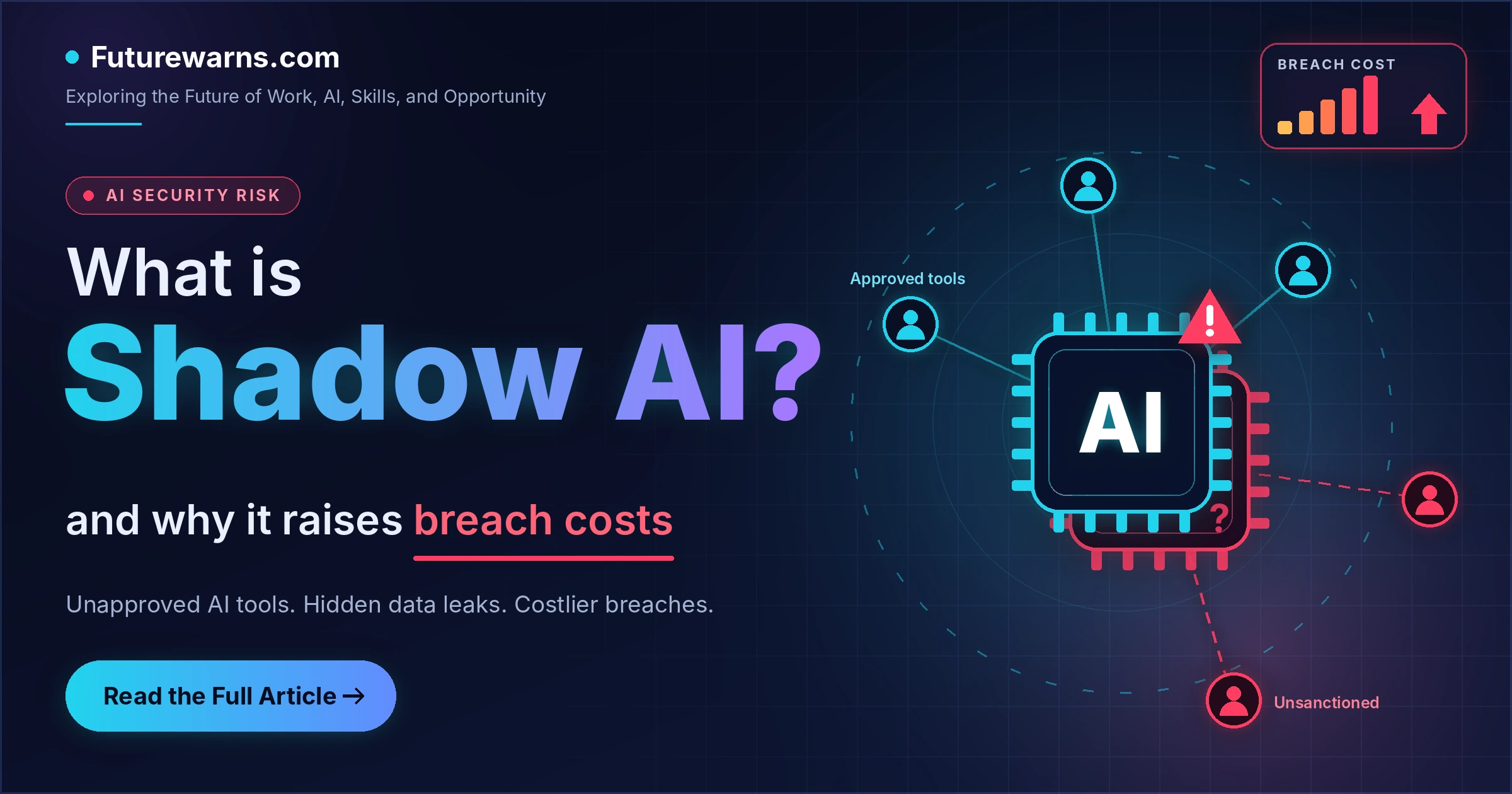
Right now, someone at your company is probably pasting work into an AI tool that IT has never heard of. They are not being reckless. They are trying to finish a report before lunch. But that one paste can put customer data, source code, or a contract outside your control. And when a breach happens, that missing control shows up on the bill.
Quick answer: Shadow AI is the use of AI tools, apps, or agents at work without the approval or knowledge of the IT and security team. It raises breach costs because it creates blind spots. Teams cannot protect, monitor, or quickly contain data they do not know is moving. In IBM’s 2026 Cost of a Data Breach Report, shadow AI was involved in 43% of security incidents (up from 20% a year earlier), and those breaches averaged $5.39 million, compared with a $4.99 million global average.
Introduction
Most security problems start with an attacker. Shadow AI usually starts with a helpful employee. That is what makes it hard to deal with.
In this guide, we will keep things simple. You will learn what shadow AI is, where it hides, why it makes breaches more expensive, and what to do about it. We use the latest public research and clearly mark where the evidence is limited.
Table of Contents
- What Is Shadow AI?
- Why Shadow AI Is Growing So Fast
- Why Shadow AI Raises Breach Costs
- The Numbers at a Glance
- Case Study: Samsung’s ChatGPT Leak
- Step-by-Step Plan to Control Shadow AI
- Tools and Frameworks That Help
- Common Mistakes
- Future Outlook
- FAQ
- Key Takeaways
What Is Shadow AI?
Shadow AI means AI use that happens outside official approval. Think of “shadow IT”, where staff used personal Dropbox accounts. Shadow AI is the same habit, but with higher stakes. An AI tool does not just store your data. It reads it, processes it, and may keep it.
Four common forms
| Type | Real-life example | Main risk |
|---|---|---|
| Personal chatbot accounts | A sales rep pastes a client list into a free chatbot to write emails. | Customer data leaves company systems. |
| AI features inside approved software | A new “AI assistant” switches on inside a tool you already use. | New data flows nobody reviewed. |
| Developer API use | An engineer sends code to an outside model API during testing. | Source code and secrets exposed. |
| Unmanaged AI agents | An agent runs under a shared login nobody tracks. | Excess access, no audit trail. |
Important: Shadow AI is different from an attack on your own AI system. In shadow AI, the tool itself may work perfectly. The problem is that nobody is watching where the data goes.
Why Shadow AI Is Growing So Fast
People adopt AI because it works. A 2024 Microsoft and LinkedIn Work Trend Index found that 75% of knowledge workers used AI at work, and 78% of those users brought their own AI tools. That habit is often called “BYOAI”.
Policies have not kept up. IBM’s 2026 report found that 68% of breached organizations lacked AI governance able to manage AI use or detect shadow AI, up from 63% a year earlier. The share requiring IT approval for AI deployments fell from 45% to 38%, and only 19% coordinated AI governance with security (as summarized by SureCloud from the report).
“Security is a process, not a product.”
— Bruce Schneier, security technologist
That quote fits here. A one-time ban is a product. Ongoing visibility is a process.
Why Shadow AI Raises Breach Costs
Here is the cause-and-effect chain, step by step.
1. You cannot protect what you cannot see
Security teams build controls around known systems. A tool they never approved has no logging, no data-loss rules, and no owner.
2. Detection takes longer
If nobody knows a tool exists, nobody watches it. A slower discovery usually means more records exposed. IBM’s research has linked longer breach lifecycles to higher costs for years.
3. Sensitive data is the usual payload
People paste what they are working on: customer details, financial figures, code, legal drafts. In the 2025 IBM report, shadow AI incidents more often exposed customer personal information and intellectual property than other breach types.
4. Regulators care
About one in five shadow AI incidents in the 2026 report led to a regulatory fine, according to press coverage of the findings. Privacy laws such as the GDPR apply no matter which tool leaked the data.
5. Access controls are missing
IBM’s 2025 report found that 97% of organizations that suffered an AI-related breach lacked proper AI access controls. Unapproved tools rarely sit behind single sign-on or role limits.
The Numbers at a Glance
| Metric | Figure | Source |
|---|---|---|
| Global average breach cost, 2026 | $4.99 million (up 12%) | IBM / Ponemon, 2026 |
| Breaches involving shadow AI | 43% (was 20% in 2025) | IBM / Ponemon, 2026 |
| Average cost, shadow AI breach | $5.39M (was $4.63M) | IBM / Ponemon, 2026 |
| AI-related breaches (own AI systems) | 21% (was 13%) | IBM / Ponemon, 2026 |
| Savings from extensive security AI and automation | $1.93 million | IBM / Ponemon, 2026 |
| Cost added by high shadow AI use, 2025 study | About $670,000 | IBM / Ponemon, 2025 |
Be careful with these numbers. The study covers 602 organizations that were already breached, across 17 industries and 16 countries (fieldwork March 2025 to February 2026). It shows a link between shadow AI and higher costs. It does not prove shadow AI alone caused the extra cost. Also, shadow AI and AI-enabled attacks overlap, so the figures should not be stacked.
Case Study: Samsung’s ChatGPT Leak
What happened: In 2023, media outlets including Bloomberg reported that Samsung semiconductor engineers pasted internal source code and meeting notes into ChatGPT while trying to fix errors and summarize discussions.
The result: Samsung reportedly restricted employee use of generative AI tools and began building its own internal option.
The lesson: The staff were not attackers. They wanted quick help. Once data is typed into an outside service, the company cannot easily pull it back. A simple, approved alternative would have solved the need and kept the data inside.
Limit: Samsung did not publish a full breach cost, so this case shows the risk, not a dollar figure.
Step-by-Step Plan to Control Shadow AI
Step 1: Find what is already in use
Check network logs, browser extensions, SaaS spending, and expense reports. Then run a short, no-blame survey. Ask: “Which AI tools do you use, and why?”
Step 2: Classify your data
Decide what must never go into outside AI: customer personal data, health records, source code, credentials, unreleased financials. Label it clearly.
Step 3: Write a one-page AI policy
Keep it short. List approved tools, banned data types, and who to ask for new tools. Long policies get ignored.
Step 4: Offer an approved option
This step matters most. If the safe tool is slower or worse, people will go around it. Provide an enterprise AI plan with no training on your data, single sign-on, and logging.
Step 5: Add technical guardrails
Use data-loss prevention, browser controls, and web filtering to flag or block sensitive uploads to unapproved AI sites. Limit AI agents to the minimum access they need.
Step 6: Create a fast approval path
Aim to answer tool requests in days, not months. Slow approvals create shadow AI.
Step 7: Train people with real examples
Show staff what a risky paste looks like. Use stories like Samsung’s. Repeat it every few months.
Step 8: Prepare your breach response
Add shadow AI to your incident plan. Know who to call, which logs to pull, and how to notify regulators within legal deadlines.
Quick checklist
- ☐ AI tool inventory created and reviewed quarterly
- ☐ Data classes banned from outside AI defined
- ☐ Approved AI tool available to all staff
- ☐ Monitoring in place for unapproved AI sites
- ☐ AI agents have owners and limited access
- ☐ Staff trained in the last 6 months
Tools and Frameworks That Help
| Need | What to look for |
|---|---|
| Discovery | SaaS discovery or CASB tools, secure web gateways, browser-based monitoring |
| Data protection | Data-loss prevention (DLP), data classification tools |
| Identity and access | Single sign-on, privileged access management, controls for non-human identities |
| Governance | NIST AI Risk Management Framework, ISO/IEC 42001, OWASP Top 10 for LLM Applications |
Vendor products change quickly, so test several against your own needs. Use the frameworks above as the neutral yardstick.
Common Mistakes
- Banning everything. Bans push use onto personal phones, where you have zero visibility.
- Writing a policy and stopping there. IBM’s data suggests many firms have rules without a way to enforce them.
- Ignoring AI inside approved apps. Features get switched on by vendors without notice.
- Leaving AI agents out of identity management. Agents with shared credentials leave no audit trail.
- Blaming staff. Fear makes people hide tool use. Curiosity brings it into the open.
Pros and cons: ban vs. approve
| Pros | Cons | |
|---|---|---|
| Strict ban | Simple message; fast to announce | Hard to enforce; drives use underground |
| Approved tools plus guardrails | Visibility; staff stay productive | Needs budget, setup, and ongoing review |
Future Outlook
Fact: Year over year, shadow AI in breaches more than doubled, and IBM found security teams using AI and automation extensively cut costs by $1.93 million.
Opinion (ours): As autonomous AI agents spread, the problem will shift from people pasting text to software acting on its own with real credentials. Expect more regulators to ask for AI inventories and proof of oversight. Teams that build visibility now will adapt more easily.
FAQ
What is shadow AI in simple words?
It is AI that people use at work without the company’s approval or knowledge, such as a personal chatbot account used for work files.
Is shadow AI illegal?
Not by itself. But if it exposes personal data, it can break privacy or contract rules and lead to fines.
How much does shadow AI add to breach costs?
IBM’s 2026 report puts shadow AI breaches at $5.39M on average, against $4.99M for all breaches. The 2025 report found about $670,000 extra for organizations with high shadow AI use. These are observed differences, not proof of cause.
What is the difference between shadow AI and shadow IT?
Shadow IT is any unapproved technology. Shadow AI is a subset where the tool can process, learn from, or act on your data.
Can small businesses be affected?
Yes. Small teams often have fewer rules and no security staff, so one careless paste can matter even more.
Should I block ChatGPT and similar tools?
Blocking alone rarely works. A better approach is to give staff an approved tool, set clear data rules, and monitor for risky use.
How can I detect shadow AI?
Review web and network logs, browser extensions, SaaS bills, and OAuth app connections. Then talk to teams about what they actually use.
Key Takeaways
- Shadow AI is AI use without security approval, and it is growing quickly.
- IBM’s 2026 report links it to 43% of incidents and an average $5.39M breach cost.
- The core problem is visibility. You cannot secure data flows you cannot see.
- Bans fail. Approved tools, clear rules, and guardrails work better.
- Start with discovery, then policy, then tools, then training.
Conclusion
Shadow AI is rarely about bad intent. It is about people solving problems with the fastest tool available. The fix is to make the safe path the easy path. Find what is in use, protect your most sensitive data, and give your team something good to use instead. Do that, and a breach becomes smaller, quicker to spot, and cheaper to handle.
Read more: 10 AI Cybersecurity Services You Can Sell as a Freelancer
Want to stay ahead of tech risks before they hit your wallet?
Explore more guides on FutureWarns and bookmark us for your next deep dive.
Sources and Further Reading
- IBM and Ponemon Institute, Cost of a Data Breach Report 2026 and 2025 (ibm.com/reports/data-breach)
- Microsoft and LinkedIn, 2024 Work Trend Index Annual Report
- NIST, AI Risk Management Framework (AI RMF 1.0) (nist.gov)
- ISO/IEC 42001:2023, AI management systems (iso.org)
- OWASP, Top 10 for LLM Applications (owasp.org)
- Bloomberg reporting on Samsung’s generative AI restrictions, May 2023
Note: Some 2026 statistics (governance gaps, fines) come from secondary summaries of the IBM report. Check the original report before quoting exact figures. Last updated November 2026.